
Stop chasing foam in your acid and alkaline lines
A grade that behaves well in a neutral system can drop out within minutes once the pH swings. Below is what changes in the foam film at extreme pH, what to check when you specify a defoamer, and how to put a sample through your own material before you commit to volume.
Foam at extreme pH is a different problem
In chemical synthesis, wastewater treatment, and parts or material cleaning, the process liquid often sits well outside neutral. Agitation, recirculation, and aeration keep drawing air into the system, and you end up with a fine, stubborn foam. It eats working volume, slows material transfer, and when it gets away from you, overflow and batch-to-batch variation follow.
How long foam survives comes down to the strength of the liquid film between bubbles. Acid or alkali shifts the ionization state of the surfactants in your system and changes how they adsorb at the interface. Film drainage slows, bubbles stop coalescing and popping, and the foam collapses far more slowly than it would in a neutral system.
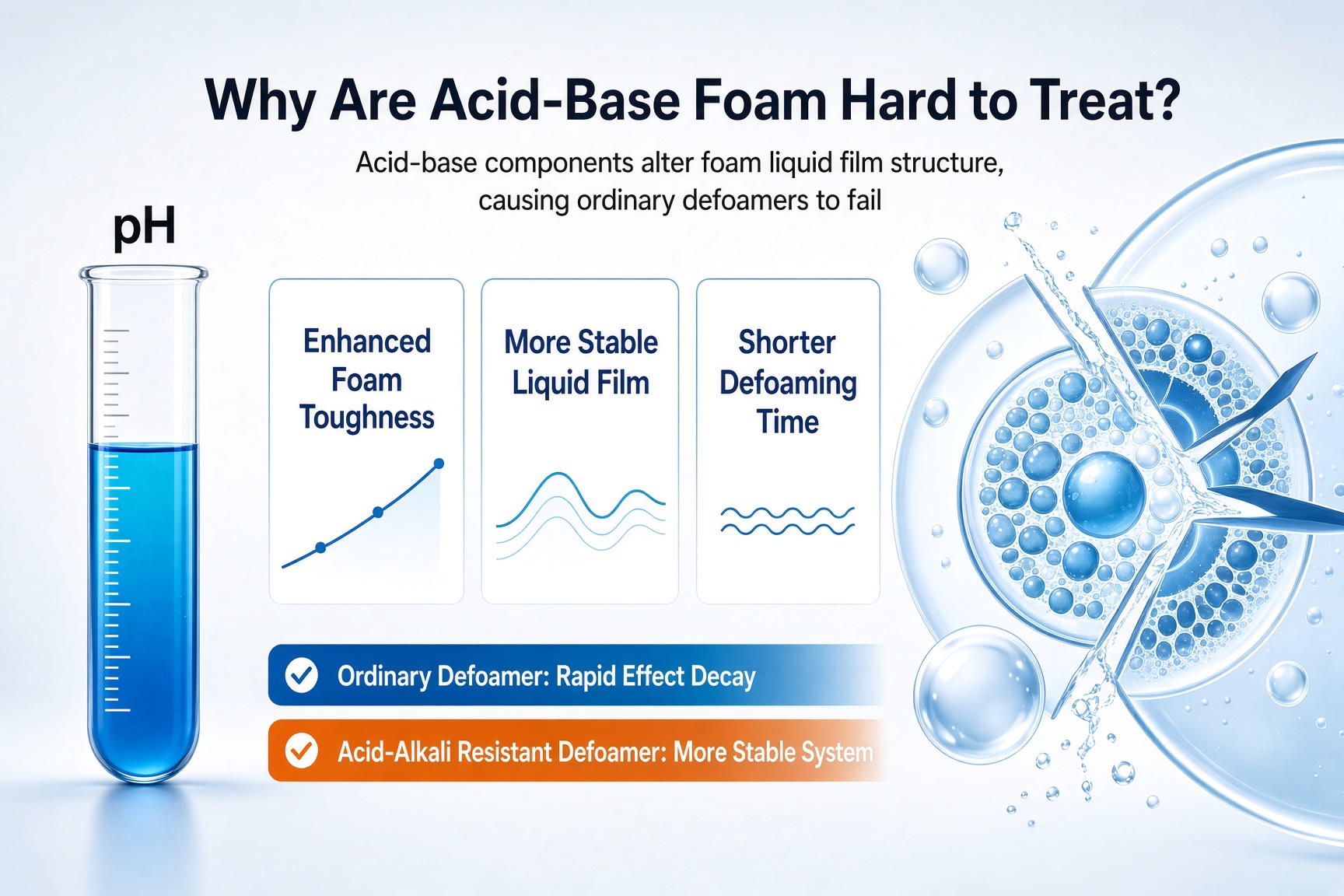
film stability and dosing decay compared
Most antifoams work through incompatibility. The active material spreads at a local point in the foam film and ruptures it. Extreme pH alters the molecular form and the emulsion state of that material, so it degrades or falls out of dispersion and loses the ability to spread.
What you see on the floor is a quick initial knockdown followed by a short suppression window. On a batch process you might never notice. On a continuous line the fade costs you directly: dosing more often, burning more chemical, and a foam level that never settles.
What a qualified grade has to hold
Four points separate a real acid- and alkali-resistant grade from a general one. Ask for tested figures against the specific grade, not against the product family.
Chemistry type. Silicone, polyether, mineral-oil-based, and non-silicone systems differ in heat tolerance, usable pH range, and how they sit in your matrix. Choose against your chemistry rather than a label.
Tested pH and temperature window. Every grade has a working range. Get the limits the supplier actually verified, and treat anything outside them as unproven.
Behaviour in your material. It should disperse evenly, without layer separation, precipitation, oil spots, or haze, and without interfering with whatever comes after the foaming step.
Hold-out time. On continuous systems, how long the foam stays down tells you more than how fast one layer vanishes. Ask for suppression time measured on your sample, then measure the same thing on your line.
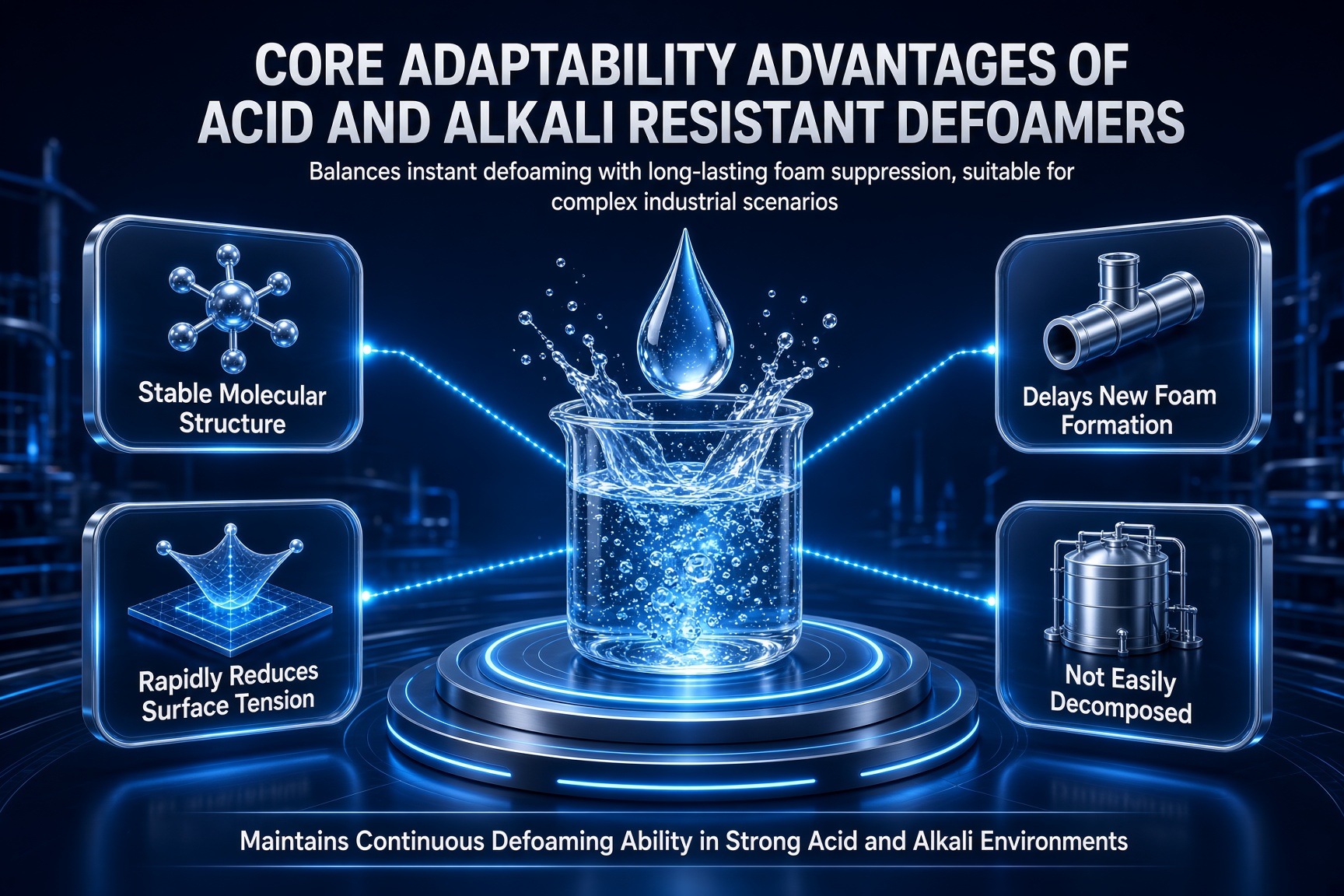
Acid- and alkali-resistant defoamer advantages, structure and surface tension
Three steps before you buy volume
Describe the system, not the symptom. Which tank or vessel, the pH you run at, the temperature, solids content, the surfactant or surfactant blend in the mix, and where the foam forms: reactor, recirculation tank, aeration basin, or pump suction.
Test on your own material. Bench-test for initial knockdown, suppression duration, and dilution stability, and watch for any effect on appearance or product performance. Bring the downstream step into the test. Foam often gets solved in the beaker and comes back one stage later.
Pilot before release. Beaker results do not scale. Aeration rate, circulation volume, and residence time all shift, so the dosing point and dosing interval need a second look at plant scale.
Pull the technical data sheet and the safety data sheet for any grade you are evaluating. Those two documents should cover the chemistry, the working range, the recommended dosing basis, storage conditions, and shelf life. If they cannot answer that, you have learned something about the supplier as well.
Dosing and day-to-day control
Set the dose against total system volume and how fast air is entering it, then work up from the low end. Overdosing stops paying back. It can leave oil spots, haze, and residue behind, and build up in recycle loops.
Add the product at a high-shear point or where foam concentrates. If you dilute it, confirm dilution stability first and use that batch the same day.
Re-test whenever the formulation changes, the batch changes, or a raw-material supplier switches. One grade rarely covers both an acid circuit and an alkaline circuit in the same plant.
Keep a log of foam height, dosing rate, and refill interval so you have a baseline. Without it you cannot tell whether the product drifted or your process did.
Frequently asked questions
Q:Can one acid- and alkali-resistant defoamer cover every pH condition?
A:No. pH strength, temperature, surfactant chemistry, and solids vary system to system, and each formulation has its own working window. Move a grade to a new application only after testing it on the new sample.
Q:Will it affect the quality of my existing product?
A:Where compatibility is verified and the dose stays inside the recommended range, it should not change the base properties of your material. If your spec is sensitive on clarity, colour, wetting behaviour, or biological activity in a treatment system, put those on your acceptance criteria and test them on purpose.
Q:What do you need from us to start?
A:Three numbers and one sentence: the pH you run at, your operating temperature, and where the foam appears. Add your monthly usage and we can quote packaging and delivery in the same reply.
Get a grade matched to your system
The cheapest place to settle a foam problem is in a beaker, not on a production line that has stopped. Nanhui has spent 20 years on industrial defoamer R&D, serving customers in chemical manufacturing, wastewater treatment, and parts and material cleaning. Tell us the pH you actually run at, your operating temperature, and where the foam appears. Our technical team will shortlist candidate grades against your system, ship a free sample for your own bench test, support an on-site trial when needed, and arrange export delivery to your plant. Until that sample holds stable results in your system, we will not recommend moving to volume.
