
If you process phosphate rock, foam is a recurring operational headache. In the digestion tank, churning foam can consume reactor volume, carry slurry onto the platform, and reduce P₂O₅ recovery. In phosphate beneficiation (flotation), over-stable foam tends to entrain gangue and lower concentrate grade.
The phosphate environment — strong acid, high heat, high solids — degrades many ordinary defoaming agents quickly. What tends to work better is an antifoam engineered specifically for phosphate beneficiation and wet-process acid production.
Why phosphate processing foams
Foam concentrates in two places:
Rock digestion / wet-process phosphoric acid: the phosphate rock + sulfuric acid reaction in the digestion tank releases large volumes of CO₂, which lift organic matter from the ore to the slurry surface and form a dense, stable foam blanket. That blanket can block vents, reduce effective reactor volume, and in severe cases overflow.
Phosphate flotation (beneficiation): collectors and frothers are added to create foam, but when it gets too thick or sticky it can entrain gangue and lower concentrate grade and recovery. Antifoam compatibility matters here.
Return-water recycling: residual defoaming agents and reagents build up in recycled water and can amplify foam downstream across the beneficiation circuit.
High-carbonate rock is a common runaway scenario during acid digestion.
Why generic defoamers struggle in phosphate plants
Strong acid: wet-process systems are highly acidic, and many ordinary silicone defoaming agents can decompose under these conditions.
High temperature: some conventional antifoam grades may volatilize or carbonize in the digestion tank.
High solids + high shear: abrasion from rock powder and gypsum can wash weaker products away.
Reagent compatibility in beneficiation: a flotation antifoam should not interfere with collectors/frothers or alter mineral surfaces.
What to look for in a phosphate-specific antifoam
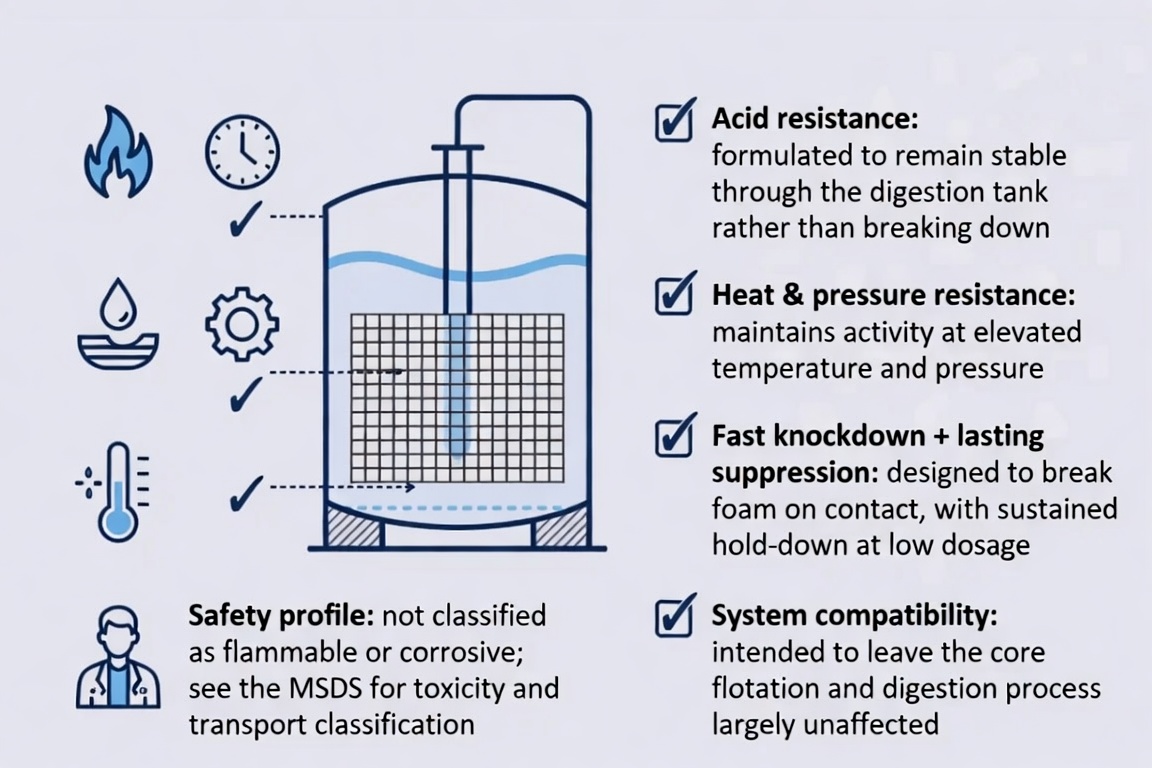
Key properties required for effective foam control in digestion tanks
The right phosphate defoaming agent holds up in hot, acidic, high-solids service, kills foam fast and keeps it down at low dosage, doesn't disturb flotation or digestion, and is non-flammable and non-corrosive per its MSDS.
Our phosphate-specific defoaming agent (models E-301 / E-302 / E-303) is built for these conditions: clear liquid, pH 5–8, non-ionic, disperses in water, with performance reported to be comparable to imported antifoam products.
Dosage & application guidance
Recommended dosage: 5–100 ppm (based on the system). This antifoam can be dosed directly; the optimal rate should be confirmed by field testing.
Application by process:
Digestion tank / wet-process acid: dose continuously by pump into the digestion tank. Start low and step up until foam is just controlled.
Phosphate flotation (beneficiation): verify compatibility first — confirm that concentrate grade and recovery are not affected. Dose at downstream points (concentrate launders / thickener feed).
High-carbonate rock: a high-penetration, low-surface-tension antifoam can help keep the foam blanket in check.
Field test method (recommended before bulk order):
Sample the digestion tank slurry or flotation pulp at field temperature, acidity and solids.
Dose from 5 ppm of the defoaming agent and check knockdown within 30 seconds.
Let it stand 2–4 hours and check for rebound.
For phosphate beneficiation (flotation), also confirm that concentrate grade and recovery are unaffected.
If foam stays controlled and your metrics hold, the antifoam is likely compatible with your system.
FAQ
Q: How many ppm of phosphate mining defoamer do I need?
A: 5–100 ppm is the recommended range; this antifoam can be dosed directly. The optimal rate depends on ore character and foam severity — confirm by jar test. Avoid over-dosing the defoaming agent.
Q: How much acid and heat can this antifoam take?
A: As a phosphate-specific defoaming agent, it is formulated to remain stable in the high-acid, high-temperature digestion tank environment, where many generic antifoams degrade quickly.
Q: Will it hurt my phosphate beneficiation (flotation) concentrate grade?
A: Specialty beneficiation grades of this defoaming agent are designed for reagent compatibility and should not affect grade or recovery when dosed correctly. We recommend jar-testing before full-scale use.
Need help selecting the right antifoam for your phosphate plant?
