
Foam control is a persistent challenge for production managers in machining workshops. When preparing semi-synthetic cutting fluids, excessive foam can overflow machine tools, waste coolant, and significantly reduce cooling and lubrication efficiency. Worse, choosing the wrong antifoam agent can destabilize the emulsion—causing cloudiness, separation, and surface defects on finished parts.
Many purchasers focus solely on "instant foam knockdown" while ignoring system compatibility, leading to costly rework and higher operational costs. To select the optimal product, you need to focus on these core technical criteria.
Priority: Evaluate Compatibility with the Emulsion System
Compatibility is the single most critical factor. Semi-synthetic cutting fluids are complex micro-emulsions containing emulsifiers and rust inhibitors. If a Semi-synthetic cutting fluids defoamer is incompatible, it can break the emulsion balance, causing the fluid to turn cloudy, separate into layers, or lose stability over time.
Practical Tip: Always conduct a compatibility test before bulk purchasing. Mix the defoamer with your cutting fluid at the recommended ratio and let it stand. Simulate high-shear circulation conditions to check for oil separation (floating oil) or precipitation.

Schematic diagram of laboratory simulation testing for defoamer samples
Select the Type Based on Workpiece Material
The market primarily offers two types of defoamers for metalworking fluids: Silicone-based and Polyether-based.
Silicone-based Defoamers: Offer rapid knockdown and long-lasting suppression at a lower cost. However, trace silicone residues may remain on workpieces, which can cause issues (like fish eyes) in subsequent painting or plating processes. Best for general machining of carbon steel or cast iron.
Polyether-based (Silicone-free) Defoamers: Ideal for precision machining of non-ferrous metals like aluminum and magnesium. They leave no silicone residue, ensuring surface quality, though their initial knockdown speed might be slightly slower than silicone types. Note: Advanced fluorine-modified polyether defoamers offer superior performance in both areas.
Recommendation: Use silicone-based for roughing steel/iron; use silicone-free polyether for finishing aluminum/alloys.
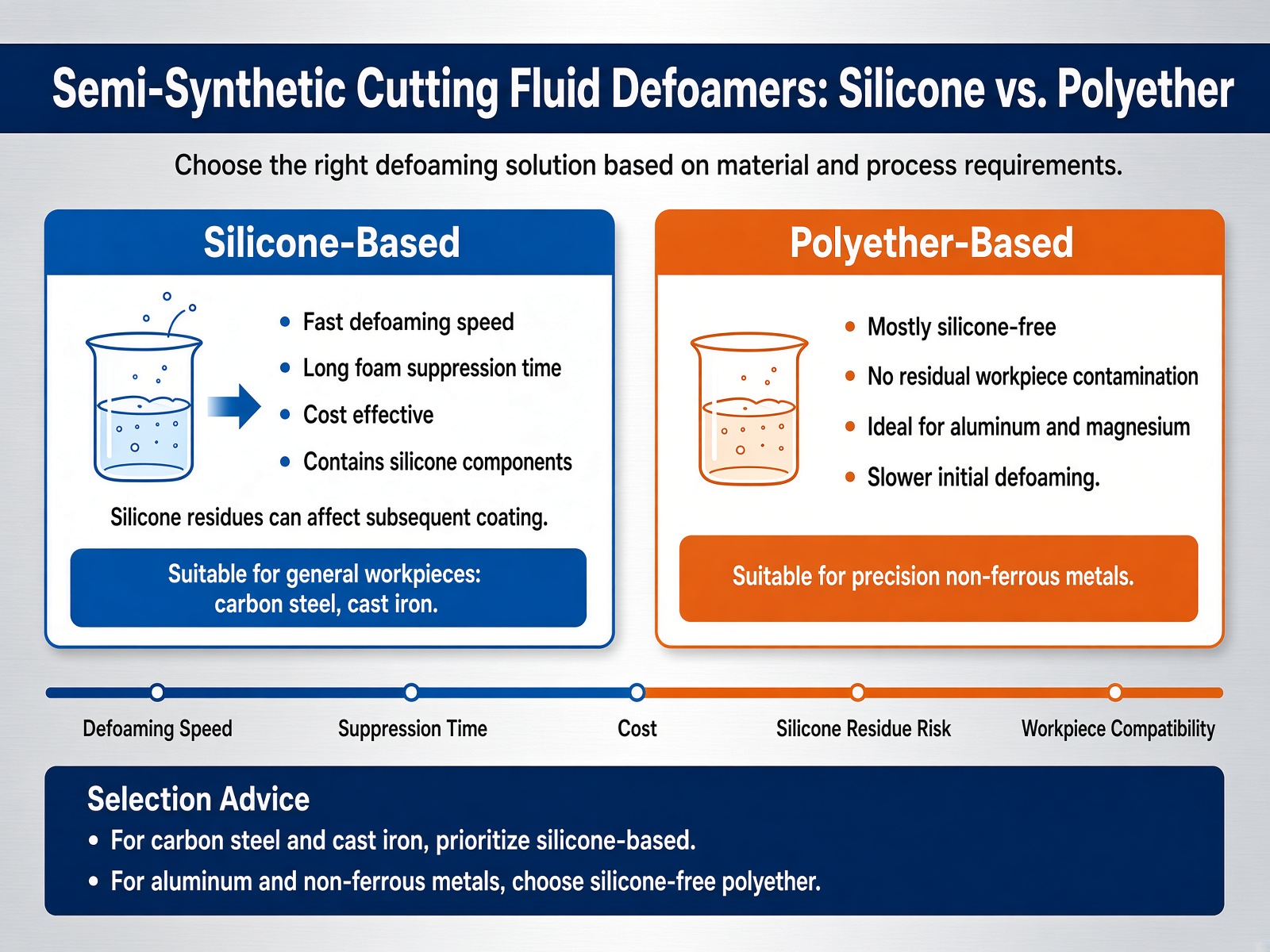
Silicone vs. Polyether Defoamer Compatibility
Focus on Long-term Suppression, Not Just Instant Knockdown
Don't be misled by how fast the foam disappears the moment you add the chemical. In high-pressure coolant systems, continuous shear forces can cause inferior defoamers to fail quickly, leading to foam rebound. This forces operators to constantly top up the tank, driving up costs. Look for products that maintain stability under continuous circulation.
Optimize Dosage for Cost Efficiency
More is not always better. Overdosing increases raw material costs and can interfere with the fluid's rust protection and lubrication properties. Determine the ideal dosage range during the testing phase to calculate the true cost-per-part.
Choosing the right defoamer isn't about finding the fastest one; it's about matching your specific fluid formulation, material, and process conditions. By prioritizing compatibility testing and distinguishing between silicone and polyether applications, you can avoid common pitfalls and ensure smooth production.
FAQs
Q1: Why did my cutting fluid turn cloudy after adding the defoamer?
A: This usually indicates poor compatibility. The defoamer likely disrupted the emulsion structure. We recommend stopping use immediately and testing a compatible model (such as a polyether-modified type) to restore stability.
Q2: Can I use a silicone-based defoamer for aluminum alloy machining?
A: It is generally not recommended for precision aluminum work. Silicone residues can adhere to the surface and cause defects in downstream processes like anodizing or painting. A silicone-free polyether defoamer is the safer choice.
Q3: Not sure which defoamer fits your application?
A: Don't guess. Contact our technical team with your fluid details (formulation type, temperature, pH, and foaming issues). We can recommend the specific grade or arrange a lab test for you.
