
In the production of gypsum boards, asbestos cement tiles, and fiber cement panels, foam is more than a surface issue. Air bubbles trapped in slurry can cause pinholes, weak spots, uneven density, and surface defects after drying. In high-speed mixing and forming lines, these problems often lead to higher rejection rates and unnecessary production costs.
A reliable defoamer for gypsum and asbestos tiles helps control foam at the right stage. It breaks existing bubbles quickly and inhibits new foam from forming during mixing, pumping, and casting. This supports smoother slurry flow, more consistent board quality, and better surface finish.
Why Foam Control Matters in Gypsum and Asbestos Tile Production
Gypsum and asbestos cement slurries are usually highly alkaline and processed under strong mechanical agitation. These conditions make foam control more difficult.
Common foam-related issues include:
Pinholes and pockmarks on the finished board surface
Lower density and reduced mechanical strength
Uneven slurry distribution during forming
Foam overflow in mixing tanks or pipelines
Higher rejection rate and increased production cost
If foam is not controlled early, it can remain trapped inside the panel. After drying or curing, these bubbles may become visible defects or internal weaknesses. That is why choosing the right defoamer for gypsum and asbestos tiles is important for stable production.
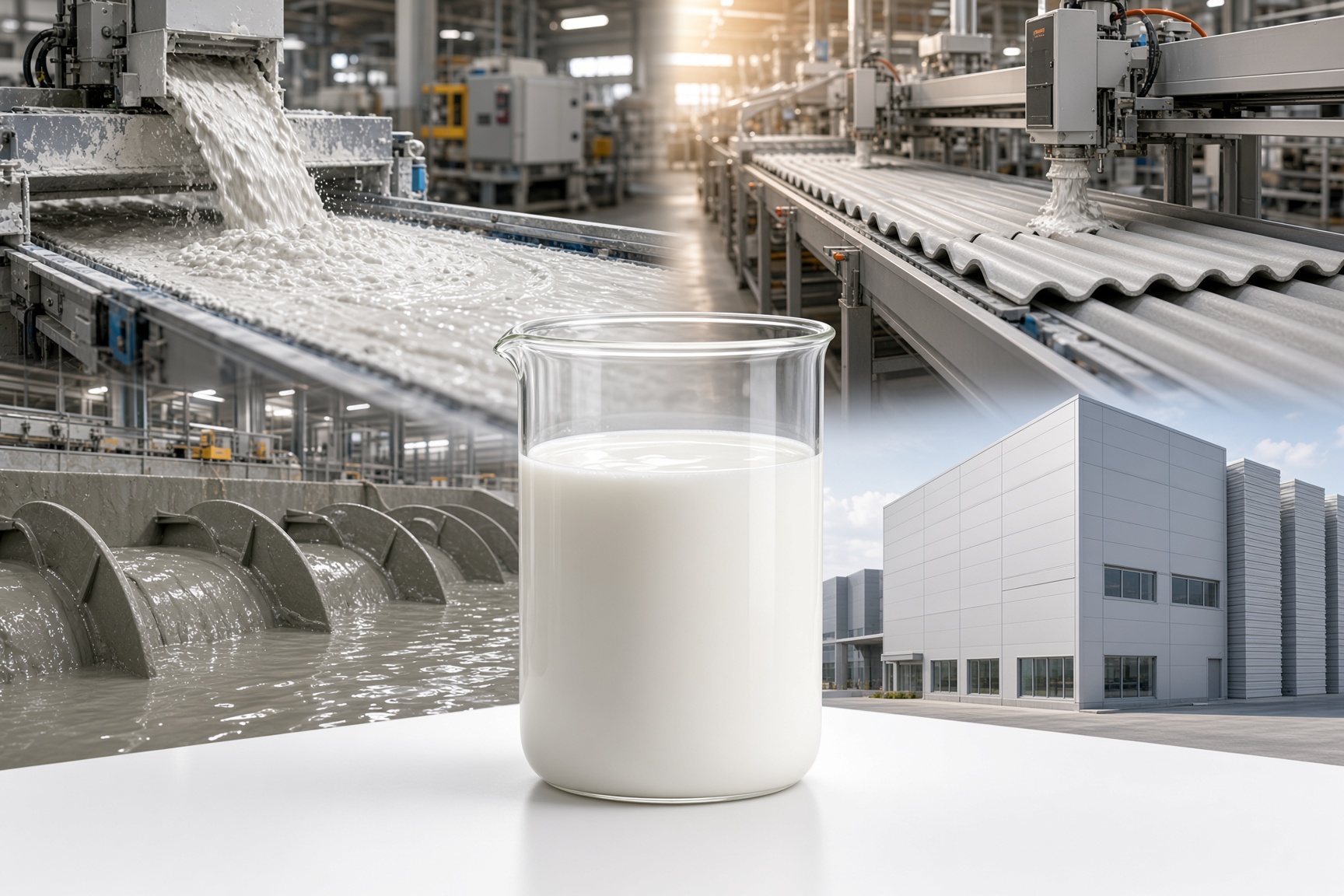
Liquid Defoamer for Gypsum & Asbestos Tile Manufacturing
How Our Nanhui Liquid Defoamer Works
Our liquid silicone-based defoamer is designed for alkaline building material systems such as gypsum slurry, asbestos cement, and fiber cement production.
It works through two main actions:
Fast foam knock-down
The defoamer penetrates the bubble film and collapses existing foam quickly.
Long-lasting foam inhibition
It remains active in the slurry to reduce the formation of new bubbles during continuous mixing and flow.
This dual action helps improve slurry workability while supporting a denser, more uniform panel structure.
Key Advantages for Building Material Manufacturers
Effective in alkaline slurry systems
Suitable for gypsum, cement, and asbestos cement environments.
Good shear stability
Performs well under mixing, pumping, and high-speed forming conditions.
Low dosage requirement
Typical recommended dosage is 0.1%–0.8%, depending on the formulation, mixing intensity, and foam level.
Helps improve surface quality
Reduces pinholes, bubbles, and surface irregularities on finished boards.
Supports consistent production
Helps stabilize slurry behavior and reduce quality fluctuations.
Recommended Dosage and Application
The typical dosage range is 0.1%–0.8% of the total system. The exact amount should be determined through trial testing.
For best results:
Add the defoamer during the mixing or slurry preparation stage.
Adjust dosage based on foam height, mixing speed, and slurry viscosity.
Conduct a small-scale trial before full production use.
Re-test when raw materials, temperature, or process conditions change.
Because every production line is different, field testing is the most reliable way to confirm the optimal dosage for this defoamer for gypsum and asbestos tiles.
Frequently Asked Questions
Q1: What is the recommended dosage for gypsum and asbestos tile applications?
A:The typical dosage is 0.1%–0.8%, depending on the slurry formula, foam severity, mixing intensity, and production conditions. We recommend starting with a low dosage and adjusting through trials.
Q2: Can this liquid defoamer be used in high-alkaline cement systems?
A:Yes. It is designed for alkaline building material slurries, including gypsum and asbestos cement systems. However, compatibility should still be confirmed through a simple jar test or on-site trial.
Q3: Will the defoamer affect the strength or appearance of the final board?
A:When used at the correct dosage, it should not cause negative effects. On the contrary, by reducing trapped air and pinholes, it can help improve surface smoothness and panel density. Overdosing should be avoided, so trial testing is always recommended.
If you want to evaluate performance in your own system, we can arrange free samples for testing. Contact us with your application details, and our team will respond with a practical foam-control solution.
