
Foam overflow in aeration tanks and MBR systems not only drags down COD and ammonia nitrogen removal efficiency but also leads to sludge bulking and membrane clogging. This article deeply analyzes the causes of industrial wastewater foam and provides a practical guide for selecting defoamers by process stage and water quality, helping you solve wastewater station foam problems at low cost.
During the industrial wastewater treatment process, regulating tanks, aeration tanks, and biochemical tanks are highly prone to generating large amounts of foam. Surfactants in the water, aeration oxygenation, microbial reproduction, and water quality fluctuations are all culprits that trigger foam. Foam overflow not only increases the operation and maintenance burden but also inhibits the activity of biochemical bacterial strains, causing fluctuations in effluent indicators.
As a commonly used auxiliary agent in wastewater stations, an industrial wastewater defoamer can effectively control foam. However, selecting the right product is the prerequisite; otherwise, it is easy to trigger secondary water quality issues.
Three Core Hazards Brought by Wastewater Foam
Industrial wastewater foam is mainly divided into three categories: chemical foam, biological foam, and mechanical foam. If not controlled in a timely manner, it will bring serious consequences:
Encroachment on Volume and Equipment Corrosion: Foam accumulation triggers tank overflow, which can even corrode surrounding equipment.
Reduction in Treatment Efficiency: Foam covering the water surface hinders oxygen transfer, dragging down the treatment efficiency of COD and ammonia nitrogen, and leading to poor sludge settling performance.
Clogging of Membrane Modules: In the advanced treatment stage, foam can easily clog membrane modules, significantly increasing overall operational and maintenance costs.
Note: Relying solely on adjusting aeration or sludge discharge can only provide temporary relief. Adding a suitable industrial wastewater defoamer is the fundamental means to handle recurring foam.
Main Types of Industrial Wastewater Defoamers and Applicable Conditions
Water quality varies greatly across different process stages, and blindly using a universal product often backfires. The following are the applicable scenarios for the four mainstream defoamers:
Silicone Defoamers: Fast defoaming speed, small dosage. Suitable for emergency defoaming in physicochemical stages such as regulating tanks and coagulation tanks. Note: Use with caution in membrane systems (prone to residue and membrane clogging); dosage must be strictly controlled in biochemical systems.
Polyether Non-Silicone Defoamers: Friendly to biochemical bacterial strains, long-lasting foam inhibition, no silicone residue. Perfectly suited for biochemical aeration tanks, MBR membranes, and water reuse stages; ideal for long-term continuous foam control.
Polyether-Modified Silicone Defoamers: Combine the characteristics of fast foam breaking and long-lasting inhibition. Resistant to acids, alkalis, high salinity, and aeration shear. Applicable to complex wastewater such as chemical and electroplating industries; universal for both physicochemical and biochemical stages.
Mineral Oil Defoamers: Low procurement cost, but weak resistance to acids, alkalis, and high temperatures, prone to oil floating and residue. Only suitable for simple ambient temperature wastewater treatment; strictly prohibited for use in biochemical and water reuse processes.
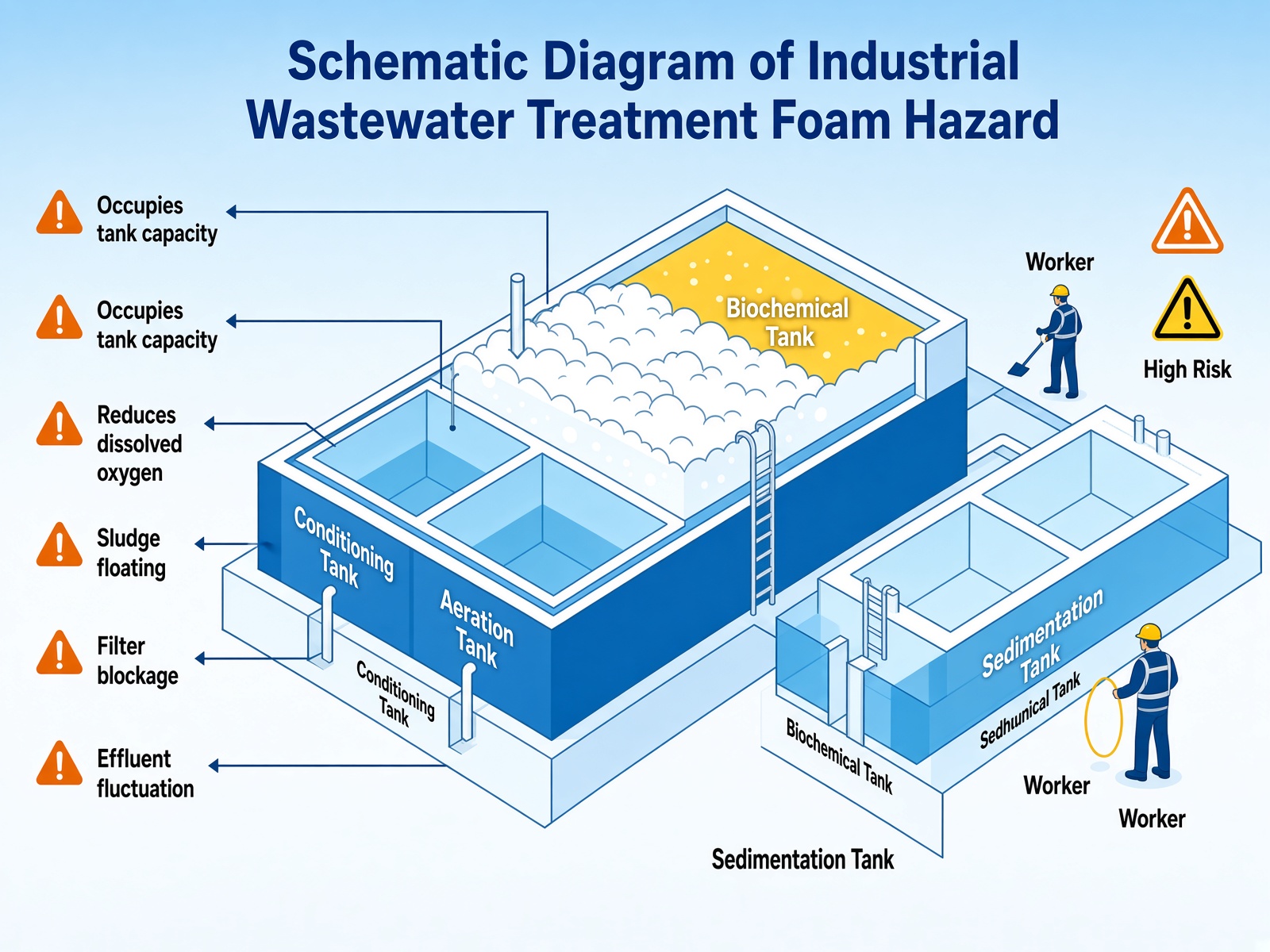
Diagram Illustrating the Hazards of Foam in Industrial Wastewater Treatment
Core Selection Points for Industrial Wastewater Defoamers
Senior environmental protection engineers suggest that the following four principles should be followed during selection:
Select by Process Stage: Use silicone for physicochemical pretreatment; prioritize polyether non-silicone or modified composite types for biochemical and membrane processes.
Select by Water Quality: Use modified silicone for complex wastewater with high salinity and strong acids/alkalis; universal silicone is sufficient for ordinary foaming wastewater.
Select by Environmental Requirements: If there are strict controls on wastewater discharge or reuse, models with low COD impact and easy biodegradability must be selected.
Conduct Small-Scale Testing: Before large-scale use, be sure to test the defoaming effect, observe if there is any oil floating or layering, and confirm that it does not affect sludge activity and effluent indicators.
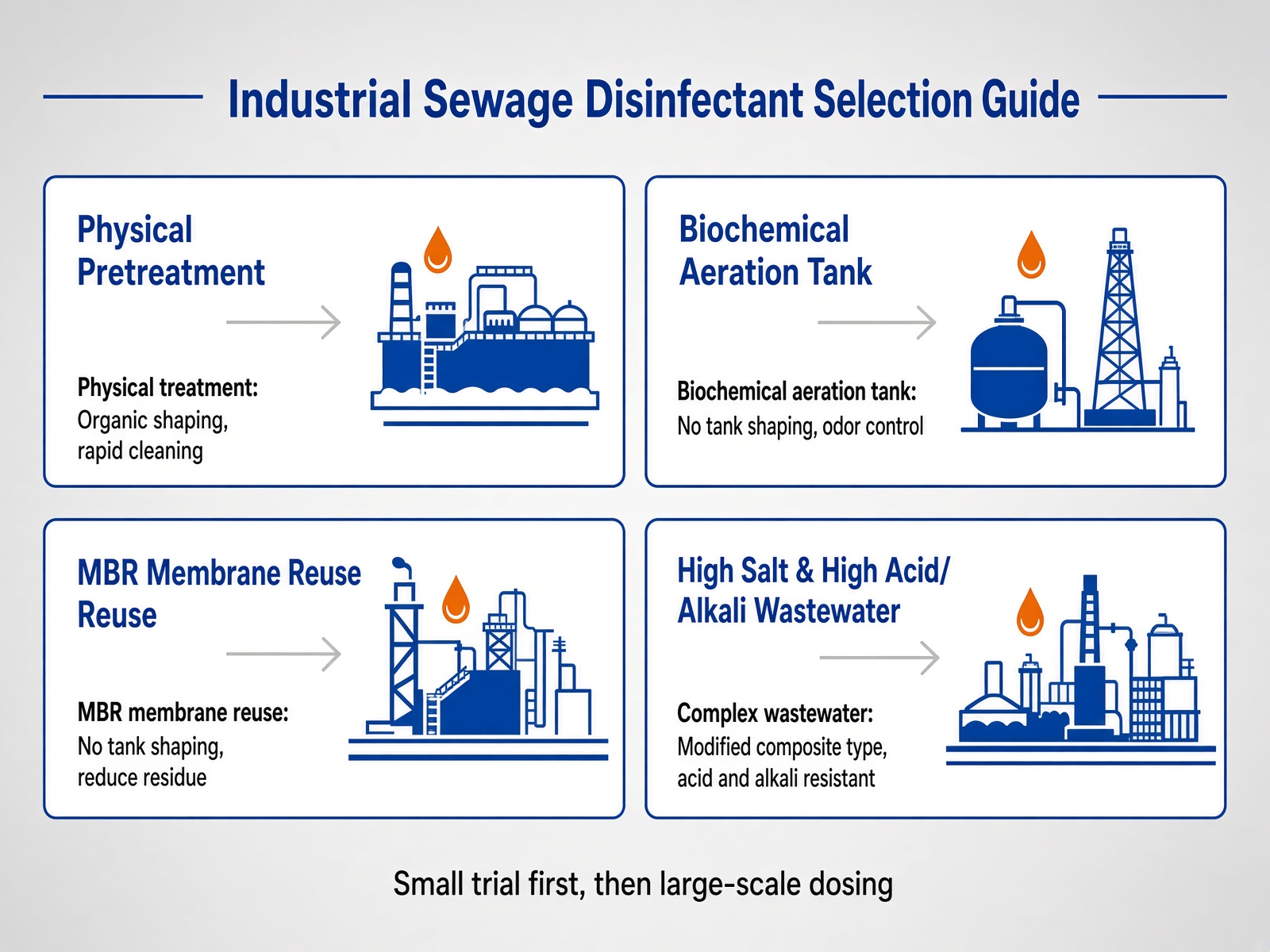
Reference Chart for Selecting Industrial Wastewater Defoamers
Practical On-Site Usage and Precautions
Dosage Position: It is recommended to choose the front end of foam generation, such as the end of the regulating tank or the influent outlet of the aeration tank.
Dosage Method: It is recommended to use a metering pump for trace amount continuous addition; during the foam outbreak stage, local spraying can be used for emergency treatment.
Dilution and Storage: Emulsion products can be diluted with clean water, but should not be stored for long after dilution. Products need to be stored in a cool and sealed place; if slight layering occurs at low temperatures, stir evenly before use.
Strictly Control Dosage: Excessive addition will lead to poor sludge settling and abnormal effluent. Be sure to precisely control it according to the actual foam situation.
Technical Summary: Industrial wastewater defoamers are process auxiliary agents and cannot completely replace source control and biochemical process adjustments. Combining wastewater quality, treatment process stages, and environmental requirements for precise selection, along with small-scale testing verification, is the only way to effectively solve foam overflow problems and ensure the stable operation of the wastewater system.
Frequently Asked Questions (FAQ)
Q1: Will industrial wastewater defoamers kill the microorganisms in the biochemical tank?
A: Compliant defoamers will not damage the bacterial strains under reasonable dosages. However, improper selection or excessive addition will indeed interfere with sludge activity. Therefore, small-scale testing is essential before production launch.
Q2: Can silicone defoamers be used in MBR membrane systems?
A: Strongly not recommended. Silicone components are highly likely to attach to membrane filaments, causing a decline in flux that is difficult to clean. For membrane processes, please prioritize polyether non-silicone industrial wastewater defoamers.
