
In high-speed textile printing and dyeing, foam is far more than a tank nuisance — it directly reduces first-quality yield.
Whether you run jet dyeing machines at 130°C, overflow dyeing, or continuous padding processes, the combination of intense mechanical shear and surfactant-rich chemicals creates ideal conditions for foam. Residual pectins and waxes from incomplete scouring further act as unexpected foaming agents under heat.
For production managers, the result is not just “messy tanks.” It is second-quality fabric and higher rework costs.
The Real Cost: White Spots, Creases, and Rework
When foam becomes trapped between fabric layers or adheres to the surface during the dyeing cycle, it forms a physical barrier. Dye liquor cannot penetrate those areas.
White Spots (Undyed Areas): The most common defect caused by foam blocking dye uptake.
Crease Marks: Excessive foam alters fabric buoyancy and friction, leading to permanent crease marks that are difficult or impossible to remove.
Pump Cavitation: In jet dyeing, air pockets reduce pump efficiency, causing circulation problems and batch-to-batch shade variation.
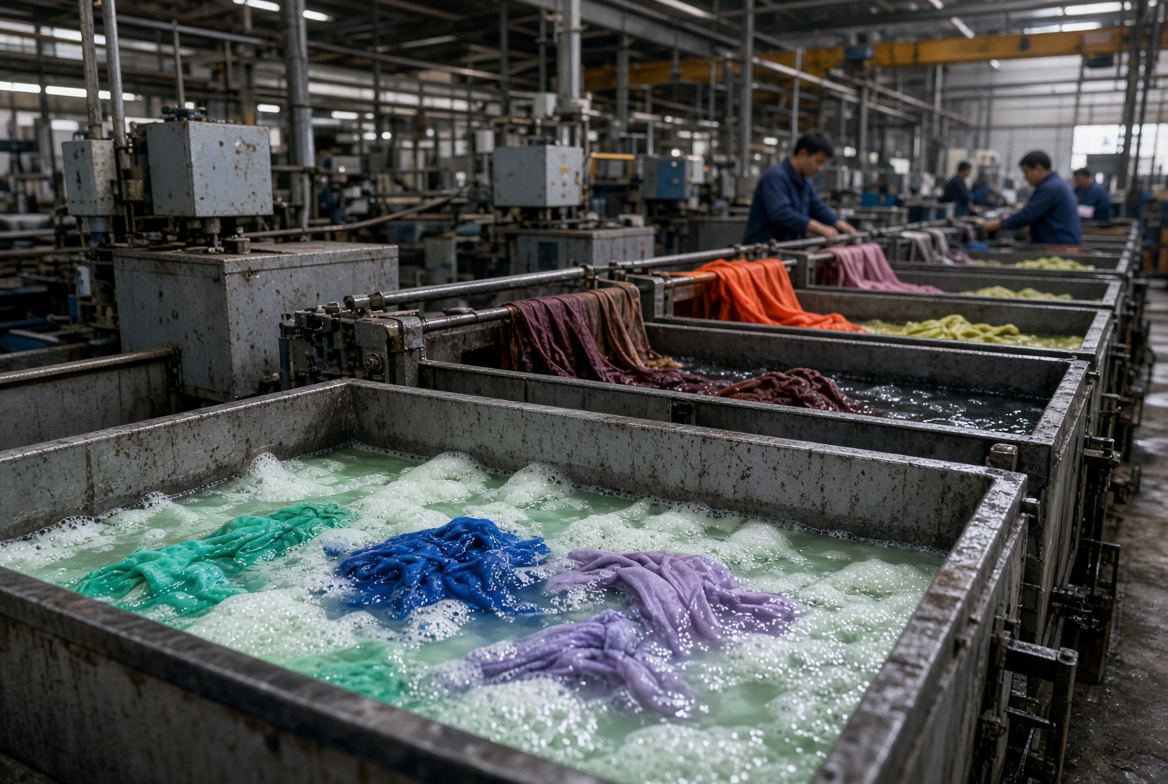
Uncontrolled foam leads to uneven dyeing and rework.
Why Standard Defoamers Often Fail in Dyeing Baths
Many mills ask: “Why not just use a cheap silicone defoamer?”
In the harsh environment of a dye bath — high temperature, high pH, and high electrolyte concentration — conventional antifoams frequently fail:
Silicone Oil Spots: If the emulsion breaks under heat or shear, free silicone oil deposits on the fabric. Removing these spots usually requires stripping and re-dyeing.
Shear Instability: High-speed jets can break down weak defoamers within minutes, allowing foam to reappear mid-cycle.
What to Look for in a Reliable Dyeing Defoamer
To achieve right-first-time production, a textile defoamer must meet three critical requirements:
High-Temperature Stability — Remain stable at 130°C without phase separation or oil spotting.
Acid/Alkali Resistance — Perform across the full pH range, from alkaline scouring to acidic neutralization.
Non-Staining & Compatibility — No interaction with dyes or finishing agents that could cause precipitation or shade change.
A well-formulated textile antifoam should also offer good shear resistance and low dosage efficiency, reducing both foam risk and chemical cost.
Conclusion
Air bubbles should never dictate your quality control. A specialized textile defoamer is a small investment compared with the cost of re-dyeing an entire batch.
If you are dealing with persistent foam, oil spots, or inconsistent dyeing results, ZKHT provides customized defoamer solutions specifically tested for textile applications. Our products are designed for high-temperature jet dyeing, overflow systems, and continuous processes.
Contact us for technical data, recommended dosage guidelines, or sample evaluation. Let’s keep your fabric defect-free and your first-quality rate high.
