
If you run a textile dyeing mill, printing line or pretreatment workshop, foam can cost more than it looks. One minute the dye liquor circulates normally; the next, the jet dyeing machine alarms, fabric tangles, and another batch ends up with uneven shade. F oam in textile printing and dyeing is not just an operational nuisance — it affects production efficiency, fabric quality and profit.
Whether you are looking for a reliable textile printing and dyeing defoamer, wondering why foam causes dye spots, or need a high-temperature solution for jet dyeing, this guide focuses on real production scenarios.
Why Foam Forms in Textile Printing & Dyeing
Textile wet processing is naturally prone to foaming. Dye baths contain surfactants such as leveling agents, penetrants, dispersants and scouring agents, which lower surface tension and stabilize air bubbles. High shear in jet dyeing machines, turbulence in overflow systems, and high temperatures — often above 130°C for polyester dyeing — make foam harder to control.
Low liquor-ratio dyeing makes it worse. Less water means higher chemical concentration and more foam. Once foam builds up in a jet dyeing machine, it can reduce pump flow, slow fabric speed, cause fabric entanglement, and lead to uneven dye uptake. The result is often shade spots, barré and batch-to-batch color variation.
Generic defoamers often fail here because they cannot withstand high temperature, wide pH ranges, and high electrolyte levels at the same time. Some products break, separate, or leave silicone spots and oil stains on fabric — defects that are difficult to correct.
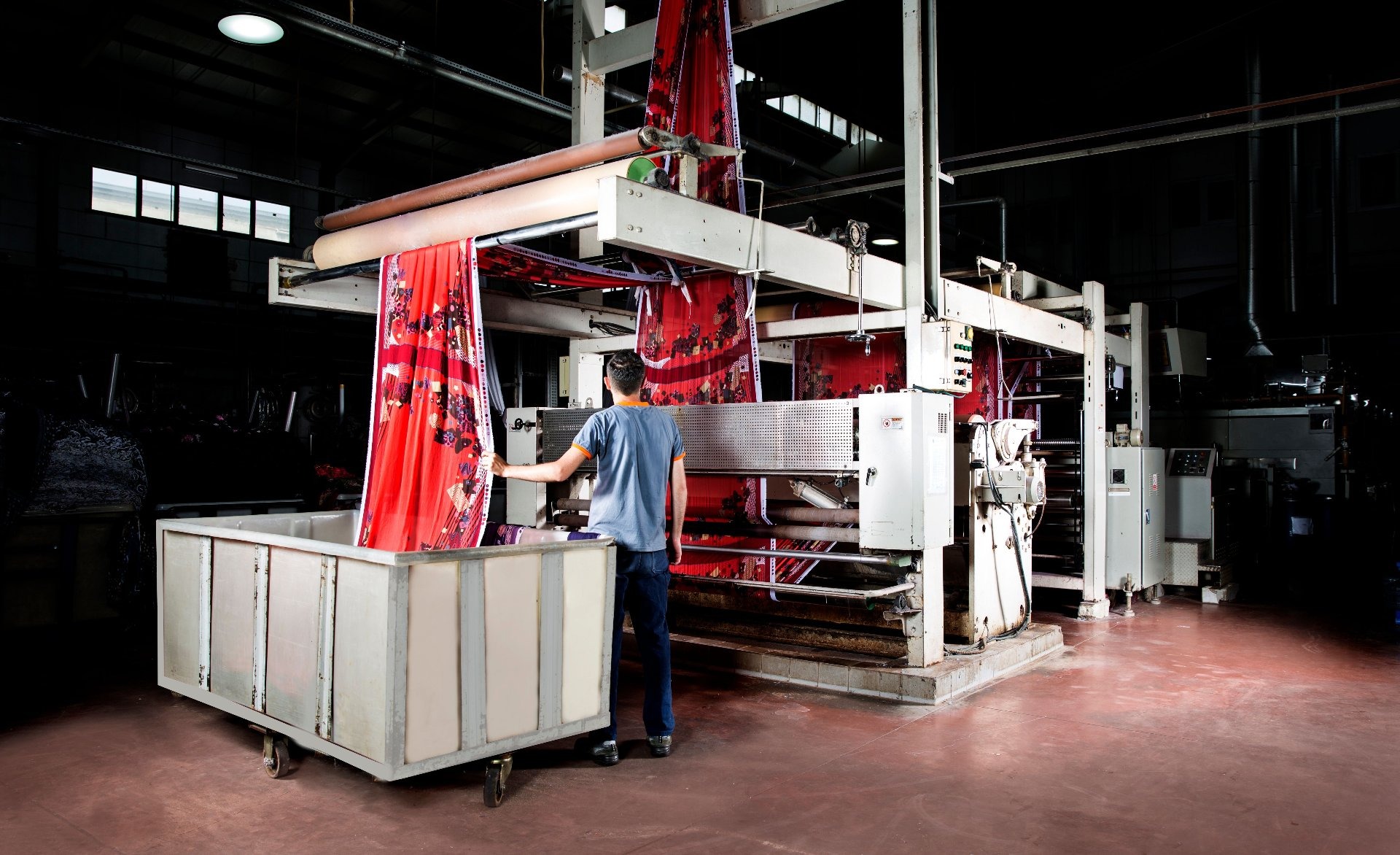
Automated textile dyeing and finishing production line
Defoamer Types That Work in Textile Processes
Polyether-modified silicone defoamers are suitable for most textile printing and dyeing applications. They combine fast foam knockdown with good compatibility, helping to avoid the silicone-spot risk common with some pure silicone products. They can perform stably around 60–135°C and in pH 4–12 environments, including high-electrolyte dye baths. They are especially useful for jet dyeing, overflow dyeing, and high-temperature polyester or blended-fabric dyeing.
Polyether silicone-free defoamers fit applications where silicone residue is not acceptable, such as printing paste preparation, silk and premium fabric dyeing, or processes followed by printing or coating. They show good compatibility with dyes and auxiliaries and help avoid oil or silicone spots. Their main limitation is lower heat resistance, so they are better suited for low- to medium-temperature processes.
Mineral oil and fatty alcohol defoamers are a cost-effective option for mild, low-temperature processes such as some finishing and softening steps. They are silicone-free and economical, but foam knockdown is slower and suppression time is shorter. They are not recommended for high-temperature dyeing or strong-alkali pretreatment.
Selection Guide by Textile Process
Pretreatment: Desizing, scouring and bleaching usually run at 95–100°C with pH above 12. An alkali-resistant polyether-modified silicone defoamer is recommended at 0.1%–0.3% of bath volume.
Polyester high-temperature jet dyeing: Conditions are demanding, typically 130–135°C in a closed, high-pressure system with high silicone-spot risk. A high-temperature silicone-composite or self-emulsifying defoamer usually performs well at 0.05%–0.2%.
Cotton / reactive dyeing: Conditions are milder, around 40–60°C and neutral to weakly alkaline, but silicone sensitivity is higher. A polyether silicone-free or modified silicone defoamer is a better choice at 0.15%–0.3%.
Printing paste preparation: This is a room-temperature, high-viscosity process with strict silicone control. A pure polyether silicone-free defoamer is usually preferred at 0.2%–0.5%.
Post-dyeing washing and soaping: The defoamer should be water-soluble and easy to rinse, because residue may affect fabric hand. A water-soluble polyether defoamer can be used at 0.03%–0.1%.
Finishing: Conditions are mild, but fabric hand is highly sensitive. A mineral oil or fatty alcohol silicone-free defoamer is recommended at 0.1%–0.4%.
3 Common Mistakes That Reduce Defoamer Performance
Adding at the wrong time. The best practice is to add the defoamer before foam builds up, ideally during bath preparation and before heating. Adding it after foam has already surged usually requires a higher dose and gives less stable control. For long dyeing cycles, plan small top-up additions.
Skipping pre-dilution. Most textile defoamers are concentrated emulsions. Adding them directly into the dye bath can create local high-concentration zones, which may cause compatibility issues, separation or fabric defects. Dilute with 3–5 times water and disperse evenly before adding.
Overdosing “to be safe”. More is not better. Excessive dosage may reduce wetting performance, cause fabric deposition, interfere with dye uptake, and even create new defects. For most textile printing and dyeing defoamers, 0.05%–0.3% of bath volume is a practical starting range.
How to Confirm the Right Defoamer for Your Dyeing Process
A suitable textile printing and dyeing defoamer should:
Knock down foam within 30–60 seconds after addition
Leave no silicone spots, oil stains or shade defects on finished fabric
Remain stable across your operating temperature and pH range
Stay uniform in the dye bath without separating, floating oil or breaking emulsion
Not affect dye shade, color fastness or fabric hand
Deliver consistent performance batch to batch
The only reliable way to confirm this is a trial under your actual production conditions. Lab tests can give direction, but they cannot fully replace testing with your own dyeing equipment, fabric, dyes and auxiliaries. Always check compatibility with your full chemical system before full-scale production.
If foam is affecting your textile printing and dyeing process, or if previous defoamers have left silicone spots and off-grade fabric, Nanhui can help review your process parameters. Share your fabric type, dyeing temperature, dye class and equipment type, and we will recommend a solution that fits your production line.
FAQ
Q1: Will a textile defoamer affect dye shade or color fastness?
A1: A compatible, correctly dosed defoamer should not affect shade or color fastness. Problems usually come from incompatible products, overdosing, or emulsion breakdown in high-temperature or high-alkali baths.
Q2: Can one defoamer cover all textile processes?
A2: Not ideally. Pretreatment, dyeing, printing and finishing have different temperature, pH and silicone requirements. It is better to select by process rather than using one product for everything.
Q3: How do I prevent silicone spots on fabric?
A3: Choose a silicone-spot-free or polyether-modified system, avoid overdosing, pre-dilute before addition, and confirm compatibility through a small-scale trial before bulk production.
