
If you run a textile sizing, paper coating, or adhesive production line, you know the scenario: your polyvinyl alcohol (PVA) solution runs smoothly one minute, and the next, the tank is overwhelmed by stubborn foam. You are not alone—this is one of the most common issues reported by PVA users in North America. Every month, foam-related raw material waste, downtime, and product rework cost plants thousands of dollars.
Let us get straight to the point. Whether you are looking for a defoamer that works in PVA solutions, wondering why PVA foams so aggressively during dissolution, or searching for a REACH-compliant defoamer for packaging adhesives, this guide gives you practical solutions based on real production environments.
Why Does PVA Foam So Easily? (And Why Generic Defoamers Fail)
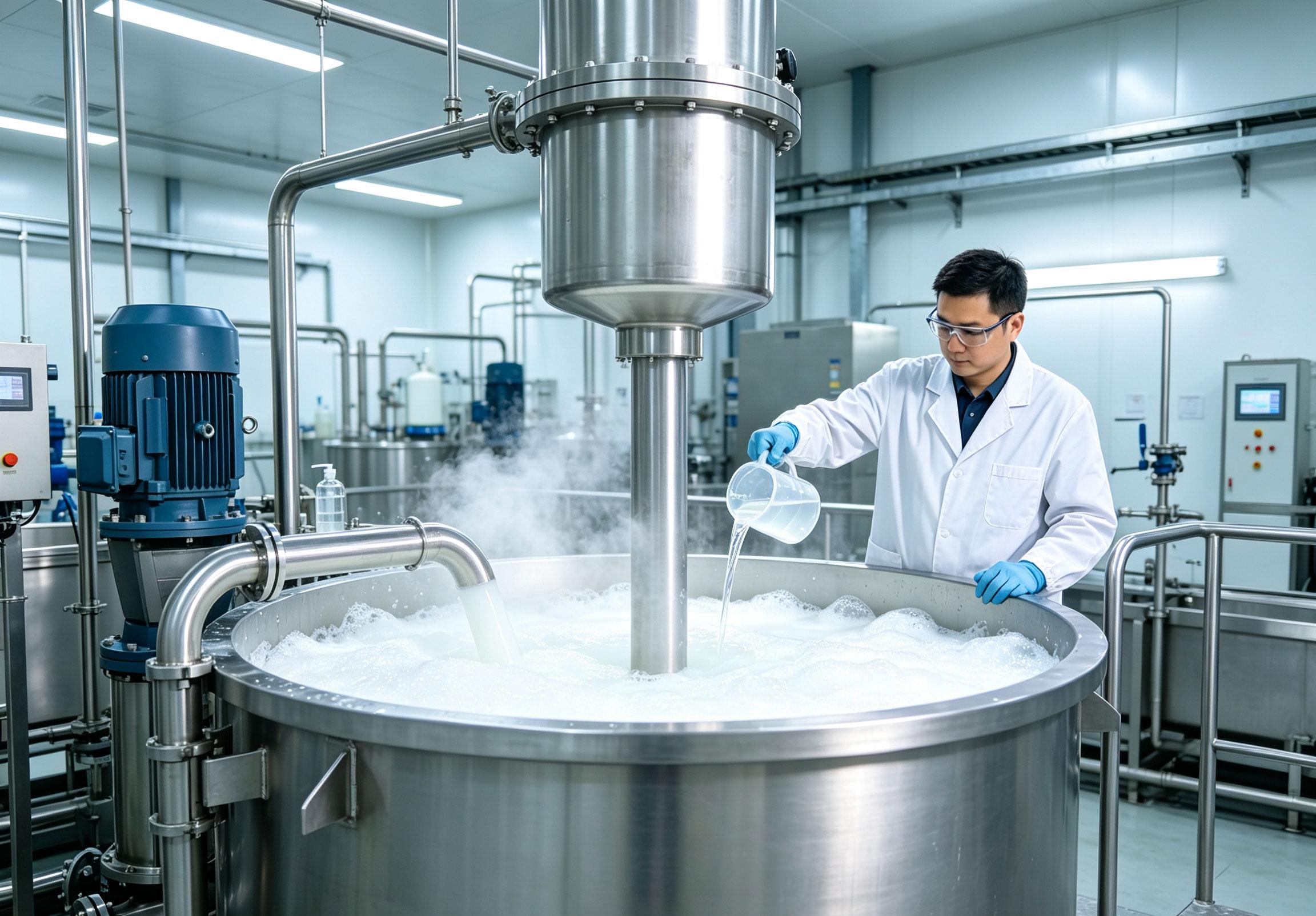
Adding specialized defoamer to PVA solution for fast foam knockdown
Most suppliers will not tell you this upfront: the molecular structure of PVA is naturally prone to foaming. The hydroxyl groups along the PVA molecular chain act like tiny surfactants, stabilizing air bubbles as soon as the solution is agitated. Add in the high-temperature dissolution (above 85 °C), high-shear mixing, and other additives such as wetting agents, and you have the perfect conditions for a foam outbreak.
The real problem is not just the foam itself—the consequences of using the wrong defoamer are far more serious. We have seen too many customers grab a generic silicone defoamer off the shelf, only to end up with fish eyes and craters in their coatings, reduced bond strength in adhesives, phase separation in PVA solutions, or foam returning within hours. PVA systems are picky. They need a dedicated defoamer that can withstand high temperatures, remain compatible with the polymer structure, deliver both fast knockdown and long-lasting suppression, and—most importantly—not compromise the performance of the final product.
Defoamer Types That Actually Work in PVA Systems
Based on our experience in real production environments, these two types deliver the most consistent results:
Polyether modified silicone defoamers are the first choice for most PVA applications. They combine the fast foam-knockdown power of silicone with the excellent compatibility of polyether, eliminating foam quickly without the surface defects commonly caused by pure silicone products. They handle the 60–100 °C temperature range typical of PVA dissolution and remain stable even under high-shear conditions.
Mineral oil-based defoamers are a reliable, cost-effective alternative if you can tolerate slight haze in the finished product. They perform especially well in textile sizing and paper tube adhesive applications, where clarity is not a primary concern.
For food-contact applications such as packaging adhesives, always confirm that your defoamer has FDA compliance documentation—not every PVA defoamer meets food-grade requirements.
3 Common Mistakes That Make Your Defoamer Fail
Even the right defoamer will underperform if you make these common mistakes:
Adding it at the wrong time. The best results come from adding the defoamer early in the PVA dissolution stage, before foam has a chance to build up. Waiting until foam has already erupted means you will need several times more product and still struggle to achieve the same level of control.
Skipping pre-dilution. Most PVA defoamers are concentrates. Adding them directly to the tank creates localized hot spots of high concentration, which can trigger compatibility issues. Dilute with three to five parts water before adding, and disperse with moderate agitation.
Guessing the dosage. The optimal dosage for most PVA defoamers is between zero point one and zero point six percent of the total formulation weight. Start low and work your way up—overdosing is far more harmful than underdosing and will not give you better foam control.
How to Know You Have the Right Defoamer
A well-matched PVA defoamer should: eliminate foam within thirty to sixty seconds after addition, leave no visible surface defects on dried films or coatings, perform consistently across your full operating temperature range, remain stable in storage without separation or settling, and deliver batch-to-batch consistency.
The only way to confirm is through a small-scale trial under your actual production conditions. Laboratory beaker tests can give you directional guidance, but nothing replaces testing with your own equipment, your own PVA grade, and your own formulation.
If you are struggling with foam in your PVA process, or have tried defoamers that promised results but fell short, Nanhui is here to help. Send us your process parameters—PVA grade, operating temperature, and application—and we will recommend a solution that truly fits your production line. What is your biggest foam challenge right now? Contact us, and let us solve it together.
FAQ
Q1: What is the best defoamer for PVA solutions?
A1:Polyether modified silicone defoamers are generally the best choice for PVA systems. They offer fast foam knockdown, strong compatibility with PVA polymers, and stable performance across the 60–100 °C dissolution temperature range without causing surface defects.
Q2: Why does my PVA solution keep foaming even after adding defoamer?
A2:PVA's molecular structure naturally stabilizes foam, and high-temperature, high-shear dissolution makes it worse. If foam persists, the issue may be wrong defoamer type, late addition timing, lack of pre-dilution, or incorrect dosage. A small-scale trial under your actual conditions is the best way to find the right solution.
Q3: Can PVA defoamers be used in food-contact applications?
A3:Some can, but not all. If your PVA is used in packaging adhesives or other food-contact applications, you must choose a defoamer with FDA compliance documentation. Always verify regulatory status with the supplier before use.
