
People looking for herbicide defoamers usually fall into two groups: formulators dealing with bead mills and filling lines, and applicators dealing with spray tanks. Formulation engineers carry a third concern: where does the foam come from, which defoamer chemistry fits, and will it affect herbicide performance? This article follows the foam path from formulation to field.
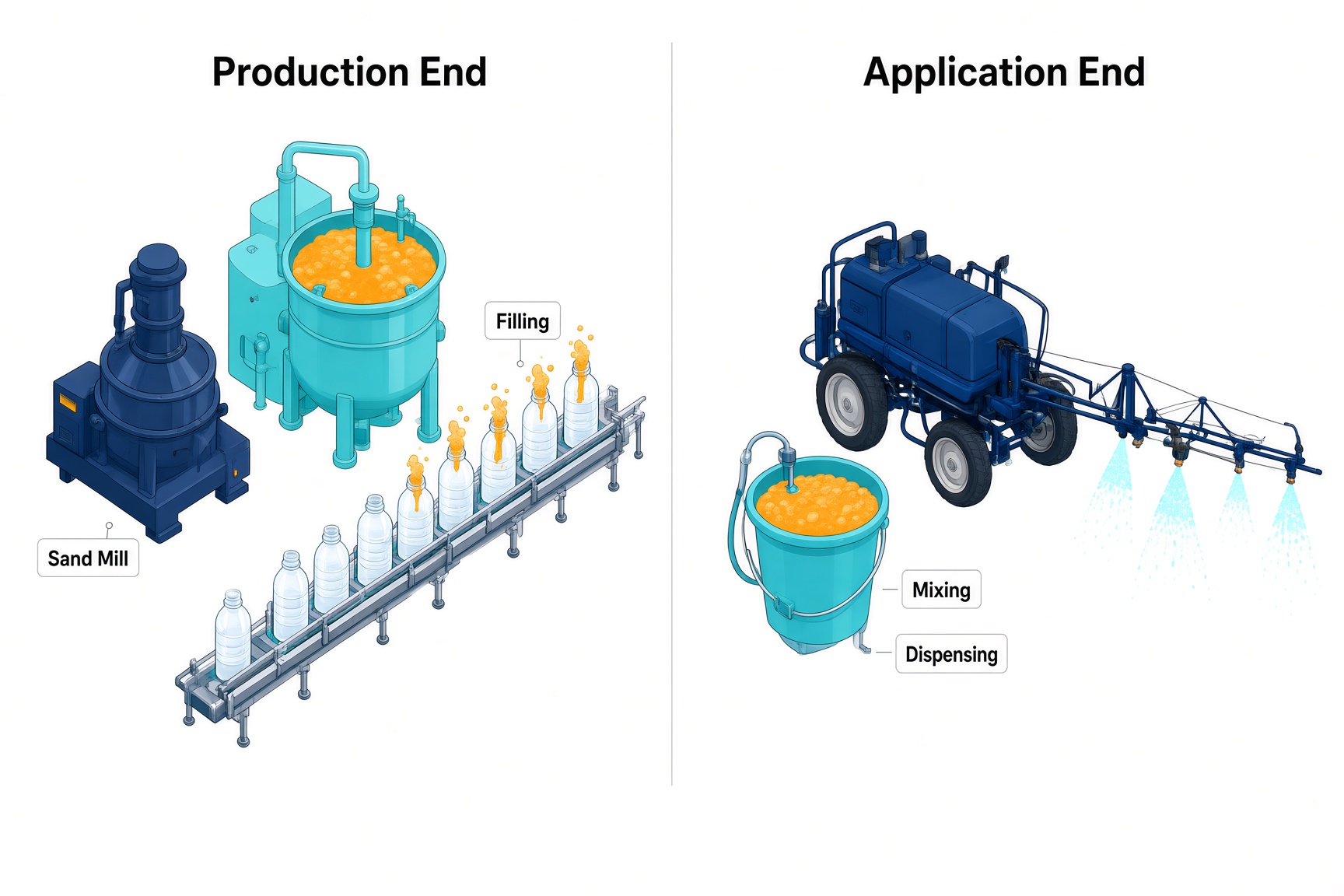
Plant vs. Field: Different foam challenges, different solutions
Why Herbicide Formulations Foam
The backbone of most herbicide formulations is surface-active substances — emulsifiers, dispersants, wetting agents, and amine salts from adjuvants. These help the spray liquid spread, stick, and solubilize, but they also stabilize foam. Glyphosate-based aqueous and salt formulations tend to foam heavily; published formulation studies often list defoamers as a standard component. In these systems, foam is more of an inherent byproduct than an avoidable accident.
Three main foam sources:
Chemical gas generation: Synthesis and hydrolysis steps release ammonia and other gases, which surface-active agents wrap into stable bubbles.
Mechanical air entrapment: Bead milling, high-speed dispersion, pump circulation, and filling drops all introduce air while reducing particle size.
Viscosity increase: Systems thickened with xanthan gum or similar agents drain slowly from bubble films, extending foam lifetime.
Production Stage: Check Compatibility First, Speed Second
Foam during milling and blending reduces grinding efficiency, skews particle size distribution, and disrupts filling accuracy. When selecting a herbicide defoamer, the first gate is not how fast it works — it is whether it stays stable in the finished product. Small-scale tests may look fine, but after weeks of storage, the product shows oil floating, phase separation, emulsion breakdown, or reduced suspension rate. Cases exist where a single adjuvant decision led to an entire batch being rejected.
Three compatibility checks before entering production:
Centrifuge test for oil floating and phase separation
Accelerated heat storage to verify system stability
Dilution test to recheck suspension rate, emulsion state, and particle size
One often-overlooked process issue: in water-dispersible granule (WG) and granulation lines, silicone emulsion defoamers may lose activity during high-shear and drying steps. Solid formulation routes often switch to powder-type defoamers or add them at a later stage. The chemical form should follow the process.
Dosing principle: Pre-adding during milling is more controlled than emergency dosing at filling. Small, continuous metering is more stable than large single doses.
Application Stage: Manage the Tank, Do Not Chase Zero Foam
Foam in spray tanks has straightforward causes and consequences: water impact combined with surface-active agents, plus tank-mix adjuvants and foliar fertilizers, all increase foaming. Overflow, inaccurate concentration, drift, and nozzle blockage can follow. Three practical habits:
Add water first, then defoamer, then herbicide; use secondary dilution to reduce impact
Start with a low dose and increase only as needed
Foam level does not directly correlate with herbicide efficacy
Foliar herbicides rely on surface-active agents for leaf spreading and adhesion — the same molecules that stabilize foam. Pushing foam to near-zero may also reduce spreading and adhesion. The goal at the application stage is "no overflow, even spray," not "clear as water." Soil-applied herbicides are generally less sensitive to foam levels.
How to Match Defoamer Type to Formulation
Silicone emulsions: Fast knockdown, broad compatibility; commonly used in suspension concentrates (SC) and soluble concentrates (SL). Watch for compatibility and oil floating in the finished product.
Polyether types: Clean dispersion, longer antifoam duration, low silicone residue concerns; preferred for transparent SL formulations and silicone-sensitive processes. Modified versions suit strong acid or alkali systems.
Polyether-modified silicones: Balance speed and persistence; increasingly used in complex formulations like microemulsions (ME) and emulsions in water (EW) with high emulsifier content.
Powder types: More stable presence in water-dispersible granules (WG) and granulation processes.
No single product covers all formulation types. Formulation type is the first question in herbicide defoamer selection.
FAQ
Q1. Will herbicide defoamer affect weed control efficacy?
A1:At ppm-level dosing with the correct chemistry matched to the formulation type, defoamers are not expected to significantly interfere with active ingredients. Beyond lab compatibility, pot trials or small plot tests provide the final confirmation. Foliar formulations especially should not be overdosed.
Q2. Foam returns a few days after adding defoamer — why?
A2:Beyond under-dosing, the more common causes are a continuous air source (recirculation flush water, residual material) or chemical incompatibility between the defoamer and the formulation. Check the process first, then adjust the chemical.
Q3. Can it be tank-mixed with silicone-based adjuvants?
A3:Tank-mix scenarios involve many variables. Run a single-tank test first to confirm that both foaming and spray spreading remain acceptable, then standardize the practice.
Send Us Your Conditions
No need to guess blindly. Contact our technical team with your fluid details (formulation type, temperature, pH, and foaming issue). We can recommend a specific grade, arrange lab testing, and send free samples.
