
During VAE emulsion production, paint formulation, and adhesive preparation, high-speed mixing and pump circulation can easily trap air inside the emulsion. These micro-bubbles do not rise to the surface quickly. Instead, they remain hidden in the liquid and break during film formation, leaving pinholes, craters, and uneven spots on the finished coating.
A suitable VAE emulsion defoamer helps control these hidden bubbles, improving coating appearance and reducing rework.
Why Micro-bubbles in VAE Emulsion Matter
Operators often focus on visible surface foam, but micro-bubbles inside the emulsion are more difficult to manage. Under high-shear mixing, air is broken into fine bubbles and dispersed throughout the system. These bubbles rise slowly and may continue to release during storage.
When the emulsion is used in coatings or adhesives, trapped bubbles can rupture during drying or film formation. This creates pinholes and surface imperfections that affect smoothness, gloss, and overall quality. In batch production, unstable appearance increases the rejection rate. Simply extending settling time slows down production and occupies more storage tanks, reducing line efficiency.
Add at the Right Stage for Better Foam Control
Micro-bubble control works best when foam is prevented early, rather than treated after large amounts have already formed.
After emulsion synthesis / during cooling: Adding the defoamer at this stage helps limit micro-bubbles generated by subsequent mixing.
During paint or adhesive preparation: It can be added early in the mixing stage to reduce air entrapment when raw materials are blended.
Avoid late correction: Adding a large dose after micro-bubbles have fully formed may lead to uneven dispersion.
After addition, maintain moderate stirring to ensure uniform distribution. Before full-scale production, run a sample test to check storage stability, film appearance, and compatibility with the VAE system.
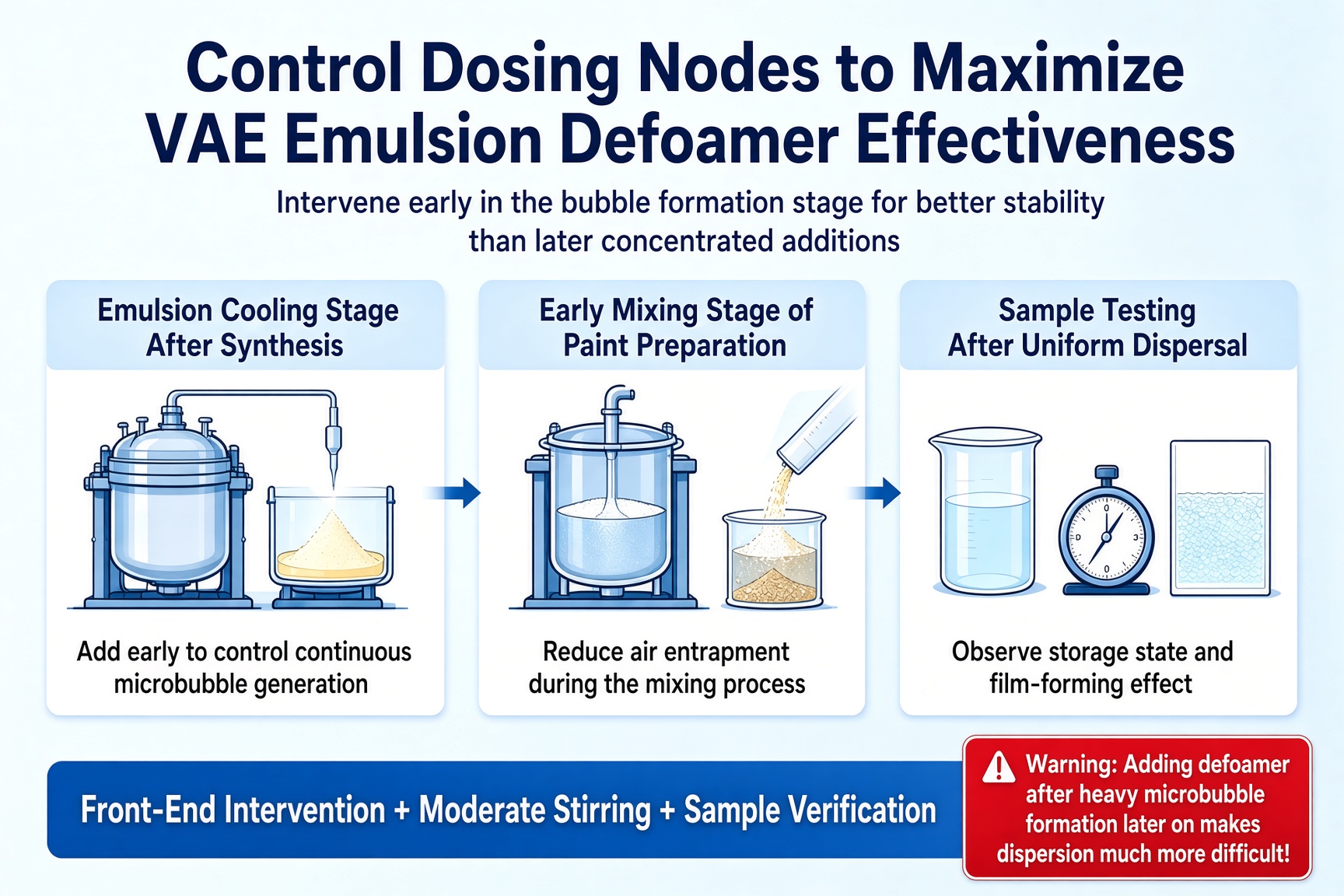
Schematic Diagram of Dosing Points for VAE Emulsion Defoamers
Support Defoamer Performance with Process Control
A defoamer alone cannot solve every foam problem. Production practices also influence micro-bubble formation.
Adjust mixing speed within the allowable range to reduce excessive shear.
Lower material drop height during feeding to minimize liquid impact and air entrainment.
Reduce unnecessary bends and negative-pressure sections in transfer pipelines to lower the risk of air intake during pumping.
When these measures are combined with a compatible VAE emulsion defoamer, foam-related quality fluctuations can be reduced more effectively.
Micro-bubbles in VAE emulsion are easy to overlook but can directly affect coating quality. Controlling air entrainment at the production line, choosing the correct addition point, and using a compatible defoamer can help reduce pinholes, craters, and other surface defects.
If your VAE emulsion, coating, or adhesive process is affected by persistent micro-bubbles, Nanhui can provide sample testing and foam-control suggestions based on your actual production conditions.
FAQ
Q1: Will a VAE emulsion defoamer affect storage stability?
A1: When used within the recommended dosage and matched to the system, it should not negatively affect storage stability. A compatibility test is still recommended before formal use.
Q2: Does a higher dosage always give better micro-bubble control?
A2: No. Excessive addition may cause surface defects or compatibility issues. The optimal dosage should be confirmed through sample testing.
Q3: Can the defoamer be added to finished VAE emulsion?
A3: It can be tried, but dispersion is more difficult at this stage. Early addition during production is usually more effective.
