
Foam is a common issue in oil-based coatings, resin synthesis, metalworking fluids and lubricating greases. Agitation, recirculation and high-shear mixing can trap air in the batch, leading to false tank levels, overflow, pinholes, craters and uneven film appearance.
Many factories find that even a good oil-based defoamer does not always perform as expected. The problem is often not only the product itself, but also the foam type, post-processing conditions and addition method. When selecting an oil-based defoamer, it is important to evaluate it together with your real production process.
Identify the foam type before selecting a grade
Not all foam behaves the same. Mechanical foam is usually caused by air being pulled into the system during stirring, dispersion or pumping. These bubbles are often larger and easier to break.
Microfoam is different. It may form from internal components, reaction by-products or trapped air in high-viscosity systems. These fine bubbles are harder to detect early and may only appear as pinholes or surface defects after film formation.
If you only judge by how quickly large surface foam disappears, you may miss the real problem. For microfoam, a defoamer with better penetration and deaeration performance is often more useful than a product that only gives fast surface knockdown.
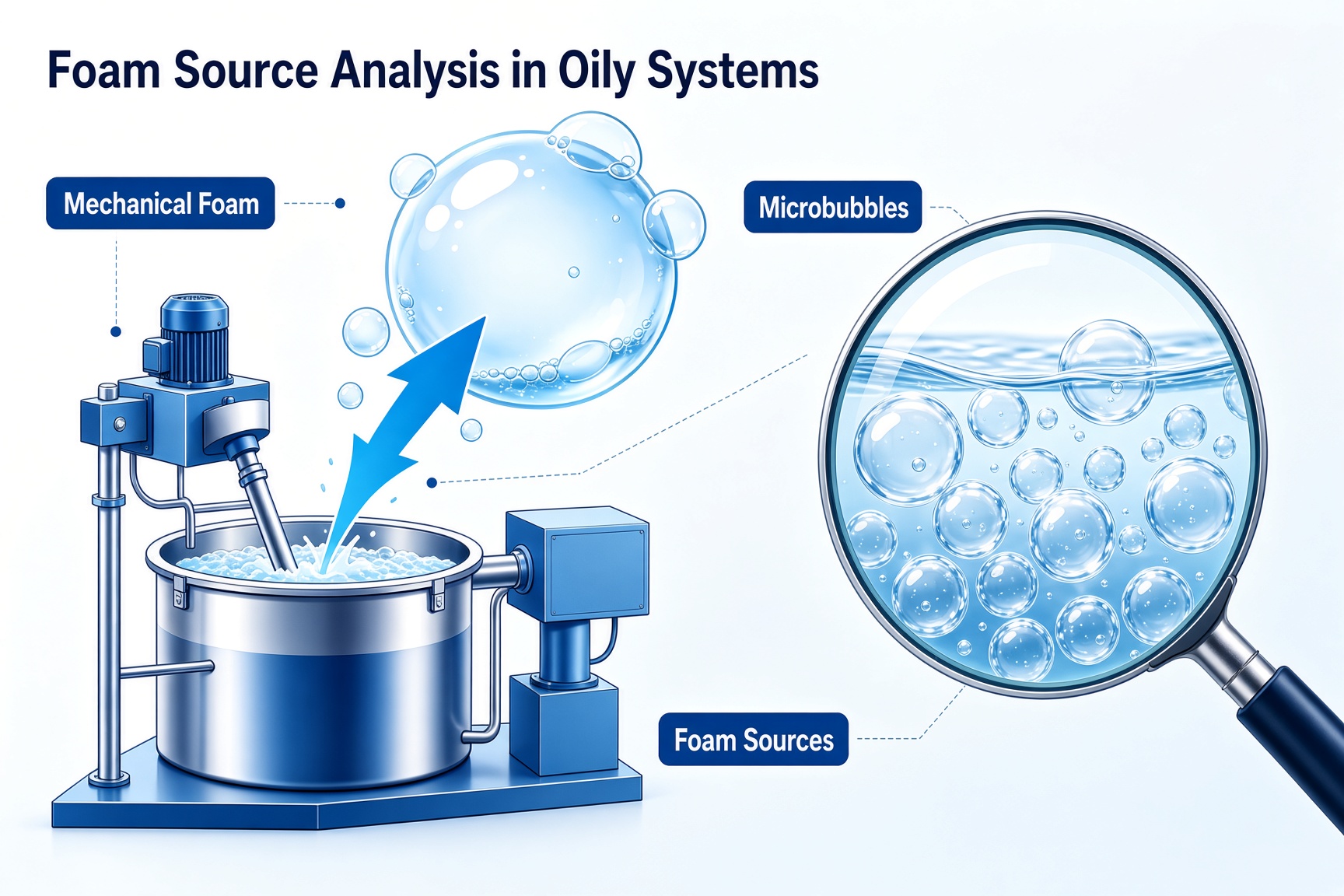
Mechanical foam vs. microbubbles in oil-based systems
Check performance after drying, curing or heating
A defoamer that looks fine in a beaker may still cause problems later. In oil-based systems, the defoamer remains in the formulation, so compatibility matters as much as foam control.
If your process includes baking, curing or high-temperature storage, check whether the defoamer causes oil spots, haze, gloss loss, cratering or adhesion issues after post-treatment. Some oil-based defoamers perform well at room temperature but may migrate or separate under higher heat.
For coatings and resin systems, always confirm that the defoamer does not reduce gloss, damage film integrity or affect bonding performance.
Add it at the right stage and in the right way
Even a suitable oil-based defoamer can underperform if it is added incorrectly. For most systems, adding it before heavy foaming starts helps improve foam prevention. Adding it only after foam overflows may reduce surface foam temporarily but may not remove fine bubbles inside the batch.
In high-viscosity materials, adding the defoamer directly as a neat liquid can cause poor dispersion. Sufficient mixing or shear is usually needed to distribute it evenly. Avoid pre-mixing it with other additives without testing, because some combinations may reduce defoaming activity.
Decide whether the defoamer should be added at the beginning of the batch, during grinding, during let-down or as a late-stage correction, based on your actual process.
Summary
Oil-based foam problems are not always caused by the defoamer alone. Foam type, post-processing conditions, addition point, dispersion and dosage all affect the final result. Do not choose an oil-based defoamer only by price or initial knockdown speed. Test it under conditions close to your real production line.
Nanhui can provide free sample evaluation and practical advice based on your material, process and foaming point, helping you reduce defective products caused by foam.
Frequently Asked Questions
Q1: Why are microbubbles in oil-based systems difficult to eliminate?
A1: Microbubbles are usually smaller and more stable, so they escape from the system more slowly. Besides choosing a more suitable oil-based defoamer, you can also adjust stirring speed, addition sequence, dispersion time and viscosity to improve deaeration.
Q2: Can oil-based defoamer be pre-mixed with other additives?
A2: It is not recommended to pre-mix it casually. Some additives may affect the activity or dispersion of the defoamer. If pre-mixing is necessary, run a compatibility test first and confirm that there is no separation, haze or performance loss.
Q3: Why did the sample test pass but oil spots appeared during mass production?
A3: Mass production usually has stronger shear, longer circulation, different temperature control and material batch variation compared with lab tests. These differences can change defoamer behavior. A pilot or production-line trial is needed to confirm the final addition method and dosage.
