
Foam overflows the troughs in a coking wastewater plant. You switch products, raise the dose, move the feed point — and a week later it happens again.
Most of the time the dose isn't the problem. The problem is treating two completely different foams with one product.
The ammonia-stripping stage generates a hot, highly alkaline chemical foam. The biological tank generates a tough, elastic biological foam. A defoamer for coking wastewater that works well in one section can be nearly useless in the other — and sometimes it makes the second section worse. Once dosing is split by stage, foam usually comes under control without increasing consumption.
This article covers what actually differs between the two stages, why a single-product approach fails, and how to pick the right type for each.
The Two Stages Demand Different Things from a Defoaming Agent
Coking wastewater treatment typically runs ammonia stripping first, then biological treatment. The foams look alike on the surface. Their causes are not.
Ammonia-stripping stage — chemical foam
The liquor here is hot and strongly alkaline, carrying free ammonia and tar/oil residues. Under steam stripping and agitation, it forms a viscous foam very quickly.
What matters in this section:
l Thermal stability — no rapid breakdown or evaporation at elevated temperature
l Alkali tolerance — performance must hold at high pH
l Resistance to being carried off by the tar/oil phase
l Fast knock-down, since foam generation is continuous and aggressive
Biological stage — biological foam
This foam is driven by microbial activity. Filamentous organisms such as Nocardia and Microthrix build a viscoelastic scum layer that clings to the surface and resists mechanical washing.
What matters here is entirely different:
l Biocompatibility — must not suppress biomass activity or disturb nitrification
l Ability to penetrate and destabilise protein-rich, elastic foam films
l No lasting impact on effluent COD or downstream processes
In short: the ammonia-stripping stage needs heat and alkali resistance; the biological stage needs to be friendly to the biology. One chemistry rarely does both well. Force a single antifoam to cover both, and you typically get one section improving while the other cycles back.
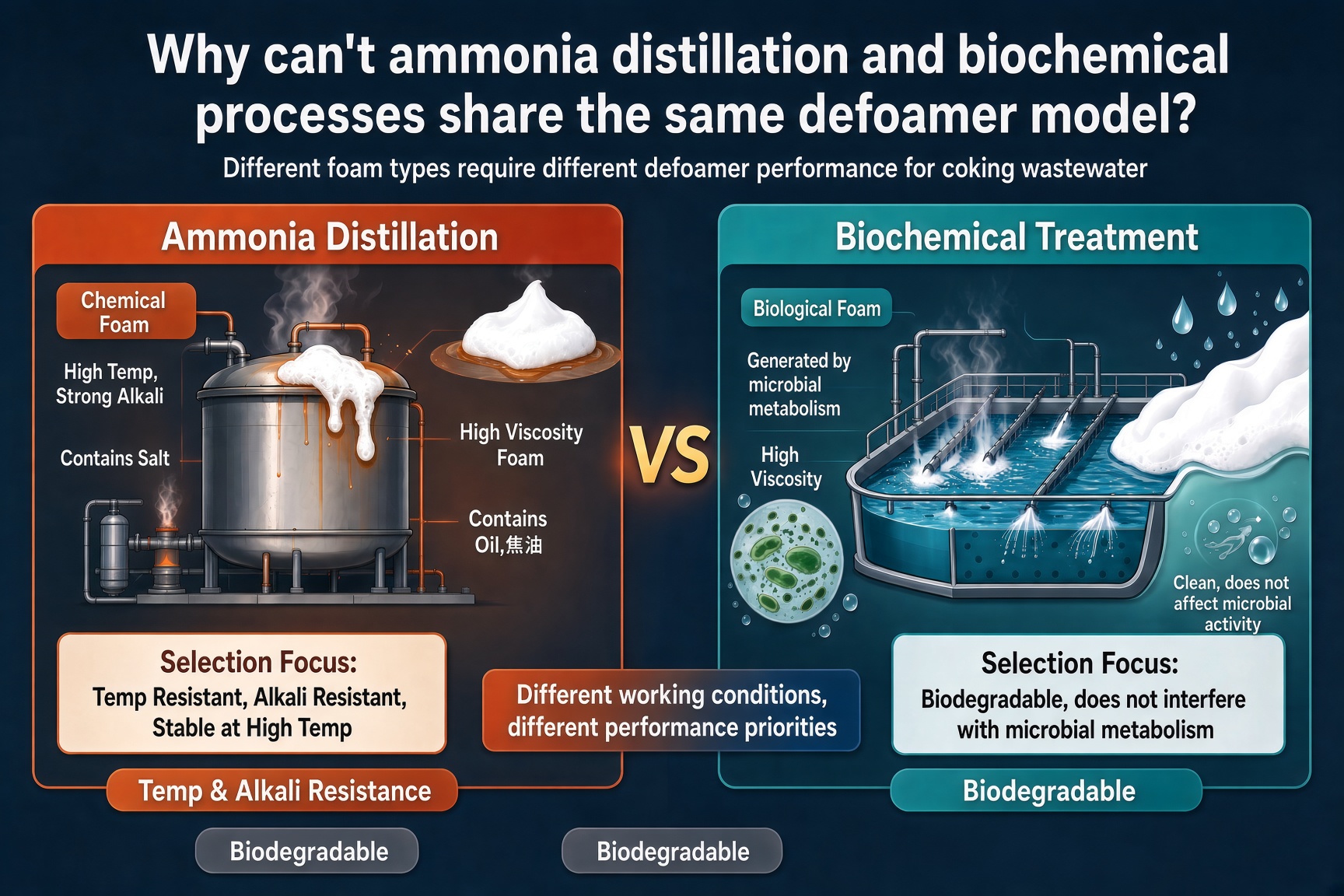
Foams differ by stage. Defoamers must be matched accordingly
What Happens When One Product Covers Both Stages
A customer running a full coking wastewater line started with a general-purpose defoamer fed across the whole plant.
First adjustment — more of the same product.
Foam in the ammonia-stripping column dropped briefly. But the extra dose travelled with the flow into the biological tanks. Biomass activity softened, effluent readings wobbled, and the team had to hold the higher dose just to keep the front end clean. That is not a stable operating point.
Second adjustment — split the product by stage.
A heat- and alkali-resistant grade was assigned to the ammonia-stripping stage, dosed near the foam generation point at a controlled rate. A separate biocompatible grade was used in the biological tanks at a lower dose, with sludge behaviour and effluent data monitored.
Result: overflow events stopped, the biological system ran steady, and total chemical consumption did not rise. The improvement came from matching, not from adding more.
If your foam problem spans both stages, treat them as two separate jobs.
Three Things to Confirm Before Choosing a Defoamer for Coking Wastewater
l Which stage is foaming. Ammonia-stripping column or biological tank — this decides the chemistry before anything else. If both are foaming, plan for two products.
l Water quality conditions. Alkalinity/pH, temperature, tar and oil content, suspended solids. These determine whether the product survives long enough to work.
l Biological system tolerance. Sludge age, whether nitrification is in place, and how sensitive the biomass has been to additives. Validate any new product with a jar test or side trial before full-scale dosing.
Where water quality fluctuates heavily — common in coking operations — choose the grade with the wider working window, and always run a sample trial first.
FAQ
Q1: Foam keeps overflowing. Will switching the coking wastewater defoamer fix it?
A1:Not by itself. First identify the source: chemical foam in the ammonia-stripping stage, or biological foam in the aeration tank. If both sections share one product, improvement will be limited regardless of dose. Then check the dosing point and frequency: feeding too far upstream, or in large intermittent shots, wastes product and pushes chemicals into sections that don't need them.
Q2: Our biological tank is foaming. How do we choose?
A2:Choose a biocompatible grade designed for biological systems, and avoid products that are essentially strong solvents or require very high doses. Run a sample trial first: check knock-down speed alongside sludge appearance, settling, and effluent readings. Start low and increase gradually — overdosing is the most common cause of biomass upset here.
Q3: Can we use one defoamer plant-wide to keep things simple?
A3:You can, but you pay for the simplicity. A product strong enough for the ammonia-stripping stage is usually overdosed for the biological tanks; a mild biological-grade product won't survive the front end's temperature and pH. If you must run one product, set the dose to protect the biological system and accept that the ammonia-stripping stage may need additional measures — optimising the feed point, water flushing, or mechanical aids.
Need help deciding which stage is driving your foam problem? Share your process conditions (stage, pH, temperature, tar content, sludge age) and we'll suggest a staged dosing plan and send a sample for trial.
