
GPE defoamer is often chosen when silicone residues are not acceptable in the process. It is chemically known as polyoxypropylene polyoxyethylene glyceryl ether, a polyether-type, non-ionic defoamer.
Unlike silicone defoamers, GPE does not rely on ultra-low surface tension or rapid spreading. Its activity is closely linked to the cloud point. Below the cloud point, GPE is relatively soluble in water and shows limited foam control. When the temperature reaches the cloud-point range, polyether molecules become less soluble, form fine active particles, and then break and suppress foam more effectively.
For typical GPE grades, the cloud point of a 1% aqueous solution is around 17–22 °C. This means performance can change noticeably with process temperature. The same product may look weak in a cold system but perform much better after the temperature rises.
Why some processes avoid silicone defoamers
Silicone defoamers are efficient and widely used, but silicone components can create risks in sensitive systems. In fermentation, membrane filtration, certain cleaning processes and high-purity aqueous formulations, even trace silicone residues may cause problems over time.
Common concerns include:
Reduced membrane flux due to silicone-related fouling
Interference with downstream purification
Surface defects such as silicone spots in coatings or cleaning systems
Accumulation risks in continuous or closed-loop processes
When silicone introduction must be avoided, GPE defoamer becomes a practical alternative because it is silicone-free and compatible with many aqueous systems.
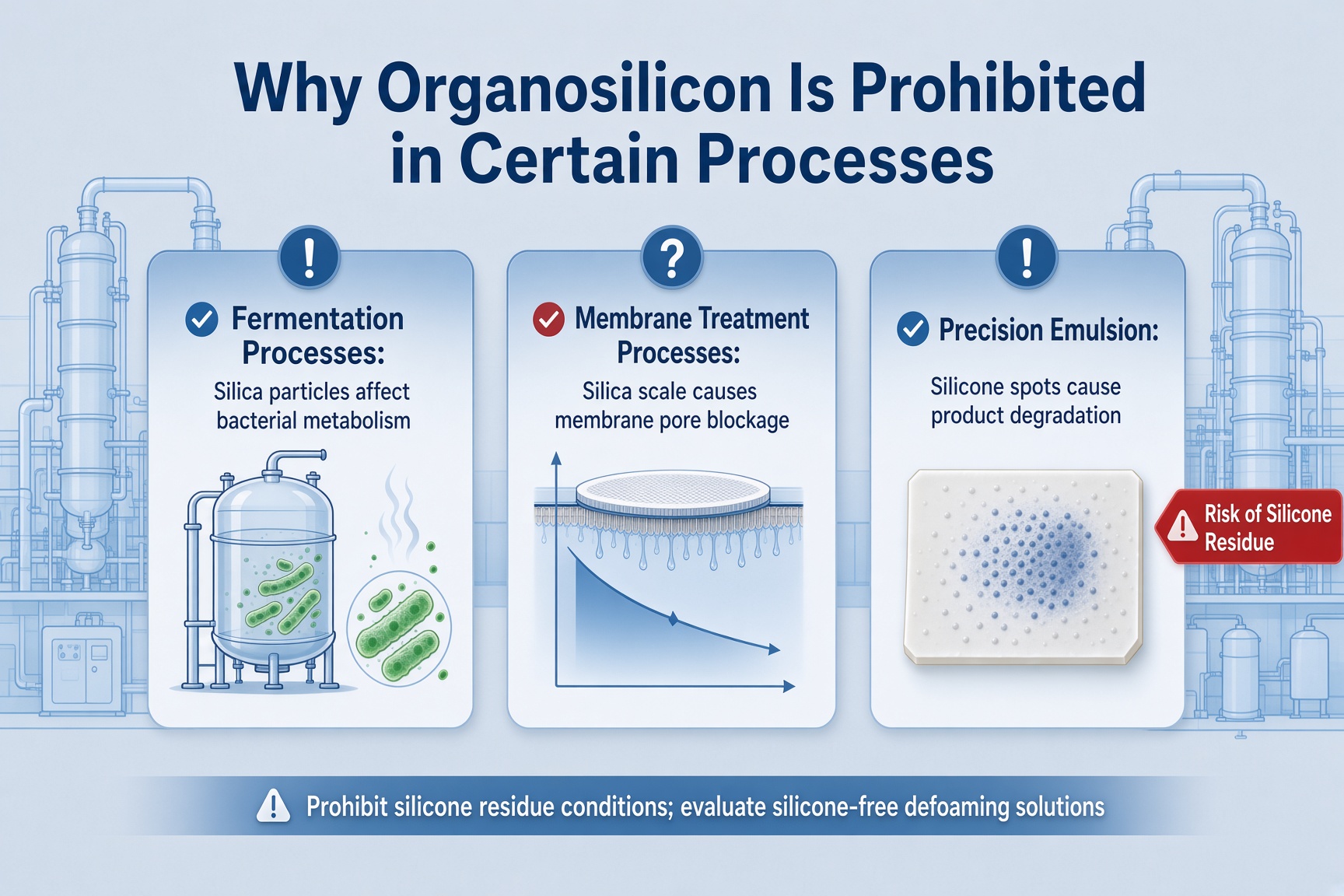
Secondary Risks of Silicone Antifoams
How GPE defoamer works
GPE defoamer does not work the same way as silicone oils. Silicone defoamers usually act through rapid spreading on the foam film. GPE, by contrast, depends on temperature-driven phase behavior.
At low temperatures, GPE stays more dissolved in water. In this state, it cannot form enough active particles at the gas-liquid interface, so foam knockdown appears slow. When the system temperature approaches or exceeds the cloud point, GPE becomes less hydrophilic, separates as fine particles, and then interferes with foam stability.
That is why field trials should always record:
Process temperature
Dilution ratio
Addition point
Mixing intensity
Foam type and formation speed
If GPE is added into a cold, highly diluted system without considering the cloud point, it may be judged as ineffective even though the chemistry is sound.
Where GPE defoamer performs well
GPE defoamer is commonly used in:
Industrial fermentation and bioengineering
Pharmaceutical and food-related fermentation
Waste water treatment
Industrial cleaning
Papermaking
Textile dyeing and finishing
Aqueous systems requiring silicone-free formulation
It is especially suitable when the process requires:
No silicone residue
Good compatibility with aqueous media
Stable foam suppression under suitable temperature conditions
Lower risk of surface defects caused by silicone oils
Limitations you should know
GPE defoamer is not a universal replacement for silicone defoamers. Its main limitations are:
Slower foam knockdown than many silicone-based products
Temperature-dependent performance due to the cloud-point effect
Limited long-term suppression in very cold systems
Reduced efficiency if added far below the cloud point
Lower suitability for some high-viscosity or heavily surfactant-loaded systems without optimization
It should not be selected only because “silicone is not allowed.” The process temperature, foam behavior and dosing method must also match the product.
Dosing recommendations
For batch processes, GPE can be added when the temperature is close to the required cloud-point range. For continuous lines, small and repeated additions usually perform better than a single large dose.
Practical tips:
Start with a low dosage and adjust by trial
Avoid adding large amounts at once
Ensure sufficient mixing after addition
Confirm the cloud point under actual formulation conditions
Test with real process liquid whenever possible
Typical dosage depends on the system. In fermentation and aqueous processes, it is often used at low ppm levels, but the final dosage should always be confirmed by plant trials.
Summary
GPE defoamer provides a reliable silicone-free route for foam control, especially in fermentation, water treatment and other sensitive aqueous systems. Its performance is strongly influenced by the cloud point, so temperature, formulation and dosing method must be considered together.
Nanhui develops polyether defoamer solutions for different temperature ranges and process requirements. We can evaluate customer samples through cloud-point simulation and foam tests, and support dosing method, addition point and temperature recommendations for stable, silicone-free foam control. Request a free sample for lab or plant trials.
FAQs
Q1:Can GPE defoamer be used at any temperature?
A1:No. GPE defoamer performs best when the process temperature is close to its cloud point. At temperatures far below the cloud point, it stays more dissolved in water and foam control may be weak.
Q2:Is GPE defoamer completely free of silicone?
A2:Yes. GPE is a polyether-type defoamer and does not contain silicone oil. However, “silicone-free” does not mean “unlimited dosage.” Excessive addition may still affect foam behavior, surface properties or downstream processes.
Q3: Should dosing be different for batch tanks and continuous lines?
A3:Yes. For batch processes, addition near the target temperature is common. For continuous processes, small and continuous dosing is usually more stable than one-time large addition.
