
Many acrylic coating manufacturers face a frustrating problem: foam seems to disappear before discharge, but bubbles reappear during storage, packaging or spray application. These hidden microfoams are difficult to detect visually. Once they break inside the wet film, they can cause pinholes, craters, uneven surfaces and costly rework.
Even when mixing speed and filtration are adjusted, the problem may persist. The right acrylic coating defoamer is often helpful for controlling microfoam that resurfaces after production.
Hidden Microfoam: The Invisible Cause of Rework
Acrylic resin systems usually have relatively high viscosity. During raw material charging, colour adjustment and mixing, air can become entrapped and form microfoam inside the liquid. A foam-free surface at the end of production does not mean all air has been released.
During storage or spray application, shear forces and temperature changes can cause these trapped microbubbles to expand and migrate toward the surface. If they cannot escape before the film sets, pinholes and surface defects may appear.
This type of defect often does not show up on the production line. It is discovered only after dispatch or on-site application, which can lead to customer complaints, batch rework and material loss.
Why Common Methods May Not Be Enough
Some manufacturers try to solve the problem by extending standing time or adding filtration steps. However, long standing times may slow down production turnover, and filtration mainly removes large bubbles or particles. It may have limited effect on micron-level microfoam already dispersed in the coating.
Many general-purpose defoamers can knock down surface foam quickly, but they may not penetrate deeply enough to destabilize trapped microbubbles. After storage or spray shear, the remaining microfoam can reappear.
A suitable acrylic coating defoamer should therefore address both:
Surface foam during production and filling
Internal microfoam that may cause defects during storage and application
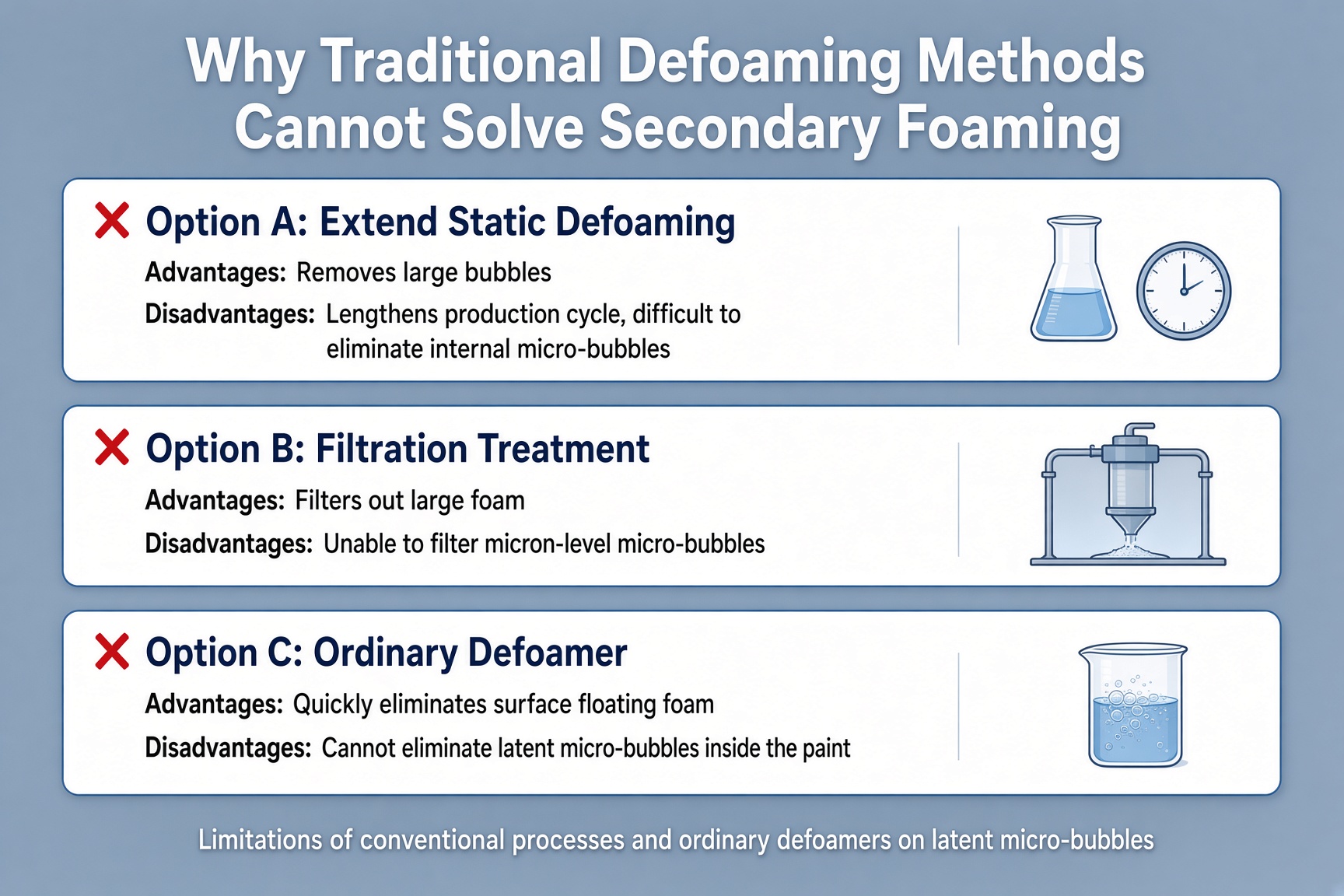
Limitations of conventional methods: surface foam only, not latent micro-bubbles
Combine Defoamer Use with Process Control
Defoamers work best when they are integrated into the production process, not added as an afterthought.
Recommended practices:
Add during colour dispersion or let-down, so the defoamer can disperse evenly throughout the system.
Avoid late-stage emergency addition, which may cause uneven distribution and inconsistent performance.
Run a simulation test before bulk packaging. Store a sample, then spray or apply a drawdown film to check for pinholes or surface defects.
Control mixing and shear intensity to help reduce air entrainment at source.
Do not rely only on the appearance of the liquid surface during production. A simple storage-and-application simulation can help identify late-stage foaming risk earlier.
Customized Support and Free Sample Trials
Quality risks in acrylic coatings often come from microfoam that remains hidden during production and releases later during storage or application. Surface foam is easier to manage, while internal microfoam may be one of the important factors behind rework and material loss.
Nanhui can provide customized defoamer recommendations based on the customer’s acrylic coating system. Please share the formulation type, viscosity, application method and foaming situation so we can suggest suitable defoamer options for trial evaluation.
Free samples are available for laboratory testing and process verification. If you are experiencing late-stage foaming, pinholes or rework issues in acrylic coatings, please contact us to request a sample trial.
FAQs
Q1: Why do pinholes appear during spraying even when no foam is visible during production?
A1: This is often caused by trapped microfoam released under spray shear. The defoamer should be evaluated not only for surface foam knockdown, but also for microfoam control and air-release performance.
Q2: Can the defoamer completely replace standing or deaeration time?
A2: No. A defoamer cannot fully replace process control. However, it may help shorten deaeration time and improve production efficiency when the dosage and addition point are properly optimized.
Q3: Can the same defoamer be used for acrylic coatings with different solid contents?
A3: Not necessarily. Viscosity, formulation and application conditions change with solid content, so microfoam behaviour may differ. Sample testing is recommended before final selection.
